

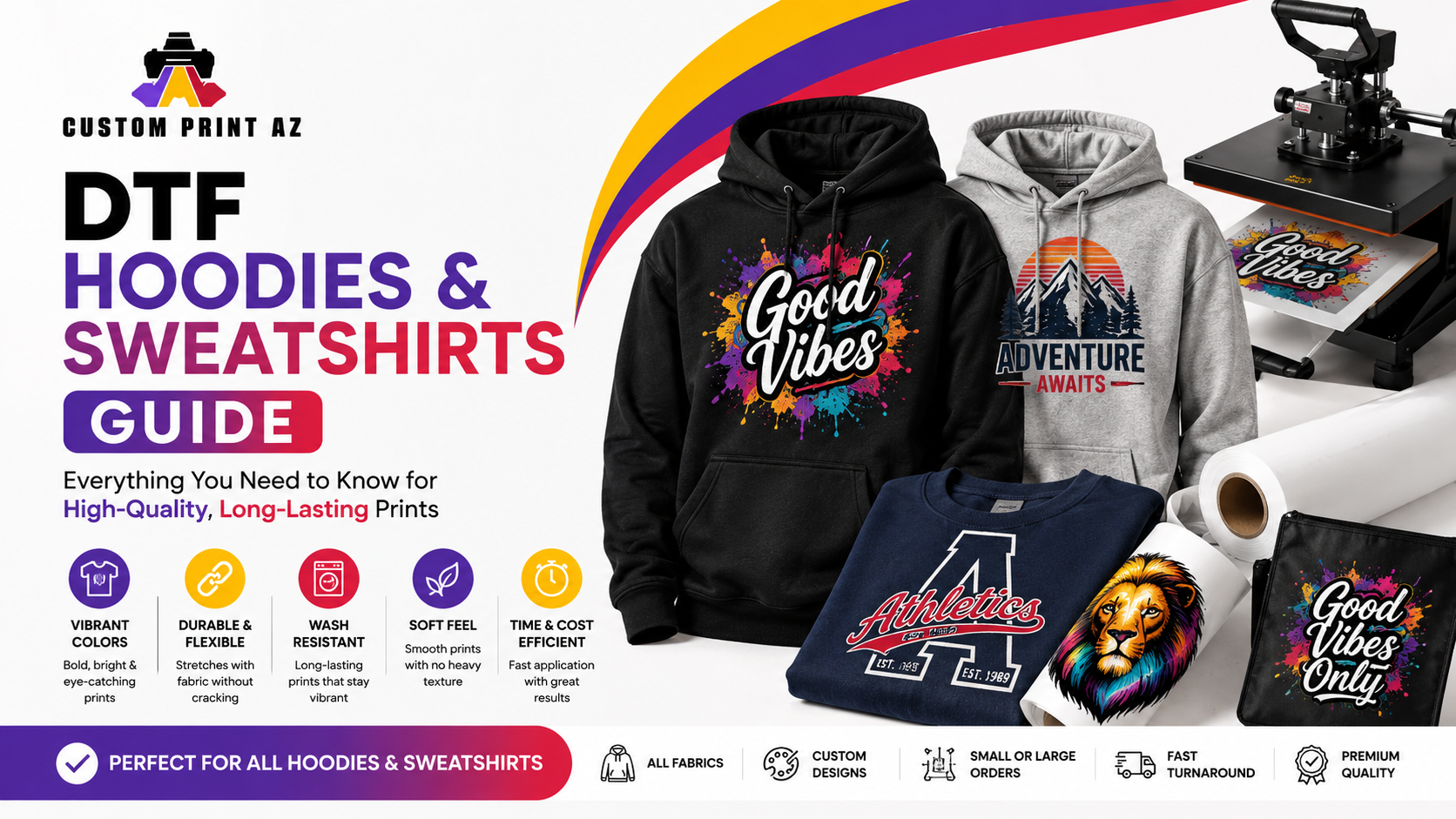
You want to put a vibrant, full-color custom design on a hoodie for your apparel brand, your team, or an upcoming merch drop. You need it to look incredibly sharp, feel soft, and survive dozens of trips through the laundry without cracking or peeling. If you have ever tried customizing heavy fleece with traditional methods, you know it can be a headache. Fortunately, DTF hoodies offer the perfect solution. Direct-to-Film (DTF) technology is the reason hoodies are finally easy to customize professionally. It eliminates the weeding required by vinyl, avoids the massive setup costs of screen printing, and bypasses the fabric restrictions of direct-to-garment (DTG) printing. This comprehensive guide will show you exactly how DTF works on thick fleece, how to choose the right blanks, how to apply your transfers perfectly, and where to order custom prints with same-day service.
What Are DTF Hoodies?
A DTF hoodie is any hooded sweatshirt that has been decorated using Direct-to-Film transfer technology. Unlike traditional printing methods that apply ink directly to the garment or require manual weeding of vinyl film, the DTF process relies on a digital printer to create your design on a specialized transparent PET film.
Once the design is printed, a hot-melt adhesive powder is applied to the wet ink and cured under heat. The resulting transfer can then be heat-pressed onto almost any piece of clothing. When you peel the film away, you are left with an incredibly detailed, high-resolution graphic bonded directly to the fabric.
Customizing a hoodie DTF style comes with unique challenges compared to printing standard t-shirts. Hoodies feature much thicker fleece material, heavy seams, front pockets, and metal zippers that can interfere with standard printing hardware.
Because DTF transfers are incredibly thin and flexible, they conform beautifully to these varied textures. This makes them highly effective for creating custom DTF sweatshirts and hoodies.
To achieve professional results at scale, using a DTF Gang Sheet Builder has become the modern way to customize hoodies. It allows you to organize multiple designs onto a single roll of film.
Additionally, while DTF transfers are ideal for flexible apparel, businesses often use UV DTF stickers for hard surfaces to ensure their hard-surface merchandise matches their clothing lines perfectly.

DTF vs. Other Methods for Hoodies — Why DTF Wins
Choosing the right decoration method for heavy garments can make or break your apparel project. For years, decorators had to choose between the stiff, plastic feel of heat transfer vinyl (HTV), the high setup costs of screen printing, or the unpredictable color vibrancy of direct-to-garment (DTG) printing on fleece blends.
Here is how DTF transfers vs. other printing methods stack up when customizing heavy sweatshirts:
- Heat Transfer Vinyl (HTV): Vinyl requires tedious weeding, which makes intricate artwork or fine text nearly impossible to execute. It is also limited to solid colors, meaning you cannot print gradients, shading, or photographic elements. On heavy fleece, HTV can feel stiff and bulky, and it often begins to lift or crack after 20 to 30 washes.
- Screen Printing: While screen printing utilizes highly durable plastisol ink, it requires a separate physical screen for every color in your design. This creates expensive setup costs and forces print shops to require high minimum order quantities (often 50+ pieces). It is rarely a viable option for small batches, custom names, or complex multicolored artwork.
- Direct-to-Garment (DTG): DTG printing prints ink directly into the fabric, but it requires a liquid pretreatment chemical that can stain or discolor certain hoodie fabrics. Furthermore, DTG struggles significantly on polyester blends, which are incredibly common in comfortable sweatshirt fleece. Without a high-cotton face, DTG prints look dull, faded, and fuzzy.
DTF solves every single one of these issues. It handles unlimited colors, requires zero weeding, has no setup fees, works perfectly on dark or light fabrics, and retains an incredibly soft hand feel.
| Factor | DTF ✅ | HTV / Vinyl | Screen Print | DTG |
|---|---|---|---|---|
| Color range | Unlimited — photos, gradients | Solid colors only | Best ≤4 colors | Unlimited |
| Weeding required | No | Yes | No | No |
| Setup cost | None | Low | High (screens) | None |
| Minimums | None | None | Often 50+ | None |
| Dark fabric? | Yes — vibrant | Yes — limited | Yes | Needs pretreat |
| Wash durability | 50+ washes | 20–30 washes | 50+ washes | ~35 washes |
| Best for hoodies | ✅ Excellent | ⚠️ Limited | ⚠️ High volume only | ⚠️ Cotton only |

How DTF Printing Works on Hoodies — Step by Step
To get the absolute best results with DTF transfers, it helps to understand the physical journey your artwork takes from a digital file to a finished piece of wearable apparel. Because hoodie fabric is dense and structured, following a precise, sequential production process ensures your graphic looks exactly as intended.
- Artwork Preparation: The process begins with high-quality digital artwork. Your design must be saved as a transparent PNG file with a resolution of at least 300 DPI. This high resolution ensures that fine details, crisp text, and clean edges do not blur when scaled up to fit a large chest, sleeve, or back placement.
- Digital Printing: The transparent file is sent to a specialized inkjet printer loaded with CMYK textile inks and a dedicated white ink channel. The printer reverses the image and prints the colored inks directly onto a clear PET film sheet or roll, followed immediately by a thick white underbase layer. This white layer acts as a visual blocker, ensuring your colors remain vibrant even on jet-black fabrics.
- Adhesive Application: While the printed ink is still wet, the film passes through an automated powder shaker or is dusted manually with a specialized hot-melt polyurethane adhesive powder. This powder sticks exclusively to the wet ink, leaving the unprinted areas of the clear film completely clean.
- Curing the Film: The powder-coated film passes through a heated curing tunnel or sits under an open heat press platen set to roughly 230–250°F for a few minutes. This heat melts the powder into a smooth, rubbery adhesive layer that bonds permanently to the ink.
- The Pre-Press (Critical for Hoodies): Before you place your transfer, you must place your blank hoodie onto the heat press and clamp it down for 5 to 8 seconds. This pre-press step drives out the deep, hidden moisture trapped inside thick fleece fibers and flattens out any fabric wrinkles. Skipping the pre-press step is the #1 cause of failed hoodie transfers, as trapped moisture will turn to steam during application, bubbling the adhesive and causing the print to peel later.
- Pressing the Transfer: Position your cured dtf print hoodie transfer sheet exactly where you want it on the pre-pressed garment. Lower your heat press platen and apply pressure at 280–320°F for 6–8 seconds using a medium-to-firm pressure setting.
- Peeling the Film: Custom Print AZ utilizes an advanced instant-peel film formula. Once the timer finishes and you lift the press, you can safely peel the clear film away smoothly in a steady, continuous motion while the transfer is still warm.
- The Second Post-Press: Place a protective sheet of parchment paper or a Teflon sheet over the exposed print and clamp the heat press down for an additional 5 seconds. This final step locks the melted adhesive deep into the woven fibers of the fabric, ensuring maximum wash durability.
Whether you are printing small design accents using individual DTF transfers by size or arranging complex clothing collections using our advanced DTF transfers by size collection, this strict application sequence is what creates retail-ready quality.

Heat Press Settings for DTF Hoodie Transfers
Achieving a flawless bond between your custom transfer and a heavy sweatshirt requires balancing temperature, time, and pressure. Because hoodies are made from a wide variety of fabric blends, using a single, generic heat setting can result in scorched fabric, ruined polyester, or weak ink adhesion.
The thickness of fleece also presents unique structural challenges. Thick seams around the shoulder, kangaroo pockets on pullovers, and heavy metal or plastic tracks on zip-up hoodies can cause the flat metal platen of your heat press to sit unevenly. This leaves lower zones with zero pressure.
To prevent this, always slide a heat press pillow or a firm foam pad inside the hoodie right under the target print area. This raises the printing surface above the surrounding seams and pockets, ensuring completely even pressure across your entire transfer design.
"Already know what you want? Custom Print AZ ships same day for orders placed before 3 PM — no minimums, no setup fees, any design. Order DTF transfers by size →"
Use this settings quick-reference guide to calibrate your heat press based on the specific type of blank garment you are using:
| Fabric Type | Temperature (°F) | Time (Seconds) | Pressure Setting | Peel Type |
|---|---|---|---|---|
| 100% Cotton Hoodie | 300–310°F | 8 sec | Medium-Firm | Warm Peel |
| 80/20 Cotton-Poly Blend | 290–300°F | 7–8 sec | Medium-Firm | Warm Peel |
| 50/50 Heavy Blend | 285–295°F | 7 sec | Medium | Warm Peel |
| 100% Polyester Fleece | 280–285°F | 6–7 sec | Medium | Warm Peel |
By dropping the temperature slightly when working with higher polyester counts, you protect the synthetic fibers from scorching and prevent dye migration—a common issue where the synthetic dyes in the hoodie bleed upward into your white ink, turning bright white graphics into a dull, muddy gray. For business owners looking to maximize efficiency across multiple garment types, utilizing a premium DTF Gang Sheet lets you gang up your artwork and press different sizing variations seamlessly.

Best Hoodies and Sweatshirts for DTF Printing
Your choice of blank apparel plays a massive role in how your final product looks and feels. While DTF transfers boast incredible compatibility with almost every fabric style on the market, understanding how different yarn structures interact with adhesive will help you pick the best blanks for your brand.
- 100% Cotton Hoodies: Pure cotton provides the ultimate ink-and-adhesive bond. The natural fibers absorb the melted adhesive powder perfectly, creating a highly durable print. Look for blanks made with ringspun cotton face yarns, which provide an ultra-smooth, low-fuzz surface for printing.
- 80/20 Cotton-Poly Blends: This blend represents the true industry sweet spot for custom streetwear brands and casual merch. The high cotton content on the outer face ensures an exceptional surface bond, while the interior polyester fleece provides unmatched softness, warmth, and stretch resistance.
- 50/50 Heavy Blends: Highly popular for budget bulk orders, promotional giveaways, and school sports teams. These heavy blends are incredibly durable and affordable, though you must drop your press temperature to around 285°F to prevent any dye bleeding.
- What to Avoid: Steer completely clear of hoodies treated with durable water-repellent (DWR) coatings or specialized stain-resistant chemicals. These performance coatings are designed to repel liquids and foreign matter, which prevents the hot-melt adhesive from locking into the fabric threads.
When expanding your product lines to include classic crewneck dtf sweatshirts, these identical fabric selection rules apply.
If you do not own a commercial heat press or simply want to take the guesswork out of the production cycle entirely, Custom Print AZ offers a professional T-Shirt Heat Press Service. You can order your custom graphics and have our experienced local team professionally press them onto your garments using industrial equipment.

How to Order Custom DTF Hoodie Transfers — No Minimums
Ordering custom transfers shouldn't require navigating complex wholesale software or paying hidden setup fees. At Custom Print AZ, we have simplified the ordering process into two straightforward, user-friendly paths designed to fit projects of any size.
Option 1: Order by Size (Single Designs)
If you only need to print a single logo or want to test a brand-new design layout before committing to a larger production run, ordering by size is your best option. You simply select your required physical dimensions, upload your transparent, high-resolution 300 DPI PNG artwork file, and choose your quantity. It is perfect for fast prototyping, sample creation, or small-batch custom requests.
Option 2: Build a Gang Sheet (Bulk & Multiple Designs)
For small business owners, Etsy shops, print-on-demand sellers, and clothing brands managing multiple design files or complex layout variants, building a gang sheet offers the lowest cost per transfer. A gang sheet allows you to nestle dozens of different graphics—including chest logos, sleeve text, back art, and neck labels—onto a single continuous roll of film.
Our intuitive, on-site digital builder tool allows you to drag, drop, resize, and arrange your artwork files perfectly on any device without needing external graphic design software like Adobe Illustrator or Canva. We use the highest quality materials to showcase the power of DTF transfers on every sheet.
We understand that speed and flexibility are crucial to running a successful apparel business. That is why we proudly offer no minimum order requirements across our entire catalog. Whether you need a single custom dtf hoodie transfer or a massive multi-yard roll, we treat your order with the same meticulous attention to detail.
All orders submitted with print-ready artwork before 3:00 PM are printed and ready to ship out the exact same day in accordance with our strict shipping guidelines. If you want to view our print quality, color accuracy, and soft hand feel in person before placing a larger custom hoodie dtf order, you can easily grab a curated sample pack to test on your heat press.
To start configuring your custom hoodies dtf layouts today, feel free to browse through our standalone DTF gang sheet collection or upload your completed production file directly using our primary upload your gang sheet portal.

Custom DTF Transfers Near Me — Same-Day Service in Phoenix
If you are operating a local apparel shop, organizing an urgent community event, or running a fast-paced streetwear brand right here in the Valley, waiting days for shipping containers to arrive across state lines can completely stall your business growth. If you are constantly searching for dependable dtf printing near me or a fast dtf transfer near me, Custom Print AZ provides a reliable local solution.
We operate a fully equipped commercial print facility located right here in Arizona. You can skip the shipping wait times entirely by opting for our ultra-fast local pickup option. Simply submit your custom artwork files online before our afternoon 3:00 PM cutoff time, and your finished, ready-to-press transfers will be waiting for you at our pickup counter that very same afternoon.
Our Physical Address:
Custom Print AZ
3411 E Corona Ave #108,
Phoenix, AZ 85040
Phone: +1 (480) 250-4263 | Email: info@customprintaz.com
By choosing a dedicated local partner rather than a massive, anonymous national printing warehouse, you get direct access to personal quality control and real-time support. Our local presence makes us the perfect partner for Phoenix sports teams, regional school organizations, local corporate events, and Arizona-born fashion brands who need a reliable custom print near me solution.
To learn more about our production equipment, our quality standards, or our community roots, head over to see our about Custom Print AZ page or contact our team directly to discuss custom commercial quotes for bulk production runs.

How Long Do DTF Prints Last on Hoodies? Wash Care & Durability
One of the most frequent questions first-time creators ask is whether a digital film transfer can truly withstand the rigorous wear and tear that heavy winter outerwear undergoes. A premium transfer from Custom Print AZ will easily survive 50+ washes without showing signs of cracking, peeling, or color fading, outlasting the useful lifespan of the blank garment itself.
The exceptional durability of modern DTF printing comes down to the science behind the adhesive layer. Instead of sitting loosely on top of the fabric surface like traditional vinyl films, the cured polyurethane powder liquefies completely under the heat press. This liquid compound flows directly around the individual woven threads of the cotton and polyester yarns, forming a permanent mechanical bond.
To ensure your custom apparel pieces maintain their retail-ready finish for years to come, we recommend including these straightforward wash instructions on your garment's care labels:
- Turn Inside Out: Always flip the hoodie inside out before tossing it into the washing machine. This simple step protects the face of the printed design from abrasive friction against zippers, buttons, and rough denim pockets from other items in the load.
- Cold Water Only: Wash your decorated garments using cool or cold water settings on a gentle cycle. High-temperature water washes can prematurely soften the set adhesive compound over time.
- Mild Detergents: Use standard household laundry detergents. Steer completely clear of harsh industrial bleaches, fabric softeners, or chemical additives, as these agents can slowly degrade the synthetic ink pigments.
- Low Heat Drying: Tumble dry your garments on low heat settings, or hang them up to air dry naturally. High-intensity commercial dryers generate extreme ambient heat that can stress and weaken the print bond.
Remember: the absolute secret weapon to ensuring maximum wash durability is the second post-press with a Teflon sheet. Taking those extra 5 seconds to press the garment after peeling the film drives the design deep into the fabric weave. This single step makes your finished prints incredibly durable and resistant to cracking.

Common Mistakes When Applying DTF to Hoodies — and How to Fix Them
Even with commercial-grade transfers, pressing onto thick fleece can occasionally present challenges if you aren't familiar with the fabric's unique properties. Here is a practical troubleshooting list of the most common mistakes decorators make when applying transfers to hoodies, along with the exact steps to fix them:
- Skipping the Pre-Press: Sweatshirt fabric is incredibly dense and behaves like a sponge, absorbing significant moisture from ambient air. If you fail to pre-press, that moisture vaporizes into steam during application, tearing through the setting glue and causing the edges to lift after a single wash. Fix: Never cut corners—always clamp your blank hoodie down for 5 to 8 seconds before introducing your print sheet.
- Ignoring Seams, Pockets, and Zippers: Trying to press a large graphic near a kangaroo pocket or thick shoulder seam without an adjustment will result in a weak bond along the edges of your design. The thick fabric layers lift the metal platen away from your design area, creating a pressure dead zone. Fix: Always place a dedicated heat press pillow or a firm foam pad inside the garment to lift your target design surface completely flat.
- Using Excessive Heat on Polyester Blends: Applying high heat (315°F+) to budget 50/50 or high-polyester fleece can trigger dye migration. This causes the synthetic fabric inks to turn liquid and gas out, discoloring your white ink backings. Fix: Drop your press temperature down to 280°F–295°F and extend your dwell time by 2 to 3 seconds to protect the synthetic fibers.
- Peeling the Film Incorrectly: Waiting until our instant-peel film cools down completely can make the carrier sheet stubborn to pull away, which can stress fine detail lines. Fix: Confidently peel the clear PET film backing away smoothly while it is still warm, immediately after lifting your press platen.
- Forgetting the Final Post-Press: Skipping the final press leaves the microscopic edges of your ink layers sitting slightly exposed on top of the fabric fuzz, increasing the risk of mechanical peeling during heavy use. Fix: Always place a clean Teflon sheet or a piece of parchment paper over your peeled graphic and lock down the press for a final 5-second hit.
- Using Low-Resolution Artwork Files: Attempting to upscale a blurry 72 DPI image found on the internet will always result in pixelated, jagged edges on your finished product. No heat press adjustment or temperature tweak can fix a low-resolution source file. Fix: Ensure all your design files are exported as transparent PNGs at a crisp 300 DPI minimum.
The absolute easiest way to completely avoid common powdering and printing mistakes is to order your pre-printed, ready-to-press custom sheets directly from Custom Print AZ. We handle the technical steps so you can focus entirely on pressing and growing your business.
Frequently Asked Questions (FAQ)
Can you put DTF transfers on hoodies?
Yes — DTF transfers work on any fabric including heavy fleece. The key differences from t-shirts: pre-press the hoodie for 5–8 seconds to remove moisture, use a heat press pillow to get even pressure over seams and pockets, and follow fabric-specific temperature settings. Done correctly, DTF prints on hoodies last 50+ washes.
What is a DTF hoodie?
A DTF hoodie is a hooded sweatshirt decorated using Direct-to-Film transfer technology. A design is printed digitally onto PET film, then heat-pressed onto the garment. The result is a full-color, vibrant print with a soft hand feel that works on cotton, polyester, and blended fleece — no weeding, no minimums.
How do you apply a DTF transfer to a hoodie?
Pre-press the hoodie 5–8 seconds to remove moisture. Position the transfer and press at 285–310°F for 6–8 seconds with medium-firm pressure. Warm-peel the film. Finish with a 5-second second press using a Teflon sheet for durability. Use a heat press pillow to get even pressure around seams and pockets.
What temperature should I use for DTF on a hoodie?
Temperature depends on the fabric blend. Use 300–310°F for 100% cotton, 290–300°F for 80/20 cotton-poly, and 280–285°F for 100% polyester fleece. Lower temperatures on polyester blends prevent dye migration, which can make white ink areas appear gray.
How long do DTF prints last on hoodies?
DTF prints on hoodies last 50+ washes with proper care: wash inside out in cold water on a gentle cycle, tumble dry on low or air dry, and avoid bleach. The durability depends heavily on applying a second press after peeling and using correct heat settings during application.
Do DTF transfers work on sweatshirts?
Yes — DTF transfers work on crewneck sweatshirts using the same settings as hoodies. The same rules apply: pre-press to remove moisture, press at 285–305°F for 7–8 seconds, warm-peel, and finish with a second press. Cotton-rich sweatshirts bond best; avoid fabrics with water-repellent coatings.
Can I order custom DTF hoodie transfers with no minimum order?
Yes. Custom Print AZ offers custom DTF hoodie transfers with no minimums — order one or one thousand. Orders placed before 3 PM ship same day. Local pickup is available in Phoenix, AZ. Use the Gang Sheet Builder to fit multiple designs on one sheet and get the lowest cost per transfer.
Get Started with Custom DTF Hoodie Transfers Today
Direct-to-Film technology is the most versatile, durable, and accessible way to customize hoodies in 2026 — full color, any fabric, no setup fees. Ready to take your apparel branding to the next level? Head over to our automated design suite to build your custom layout in minutes, or explore our single-print sizing options to test out your newest artwork concepts with zero risk. Don't forget that we offer same-day shipping nationwide for all orders placed before 3:00 PM, alongside convenient local pickup at our main Phoenix facility.


