

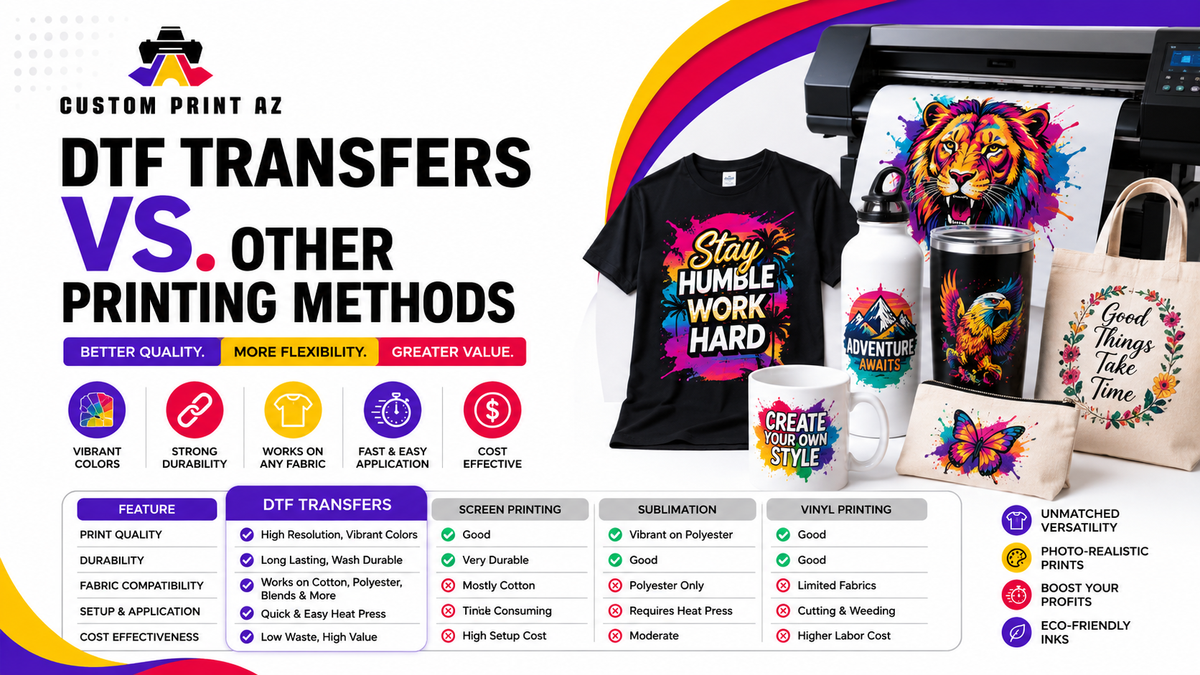
DTF, screen printing, DTG, sublimation, and heat transfer vinyl can all produce custom apparel, but they solve different production problems. The right method depends on your artwork, garment, quantity, design variety, application workflow, and whether the same graphics will be reordered later.
This guide compares the major apparel decoration methods from a practical production perspective so you can choose an option that fits the project rather than relying on a single claim about which printing technology is “best.”
Quick Comparison of Apparel Printing Methods
- DTF transfers: A transfer-based option that separates printed transfer production from final garment application.
- Screen printing: Uses prepared screens to apply ink directly to garments.
- DTG printing: Digitally prints artwork directly onto the garment.
- Dye sublimation: Uses a material-specific digital transfer process and should not be treated as interchangeable with DTF.
- Heat transfer vinyl: Uses cut vinyl elements that are positioned and heat-applied to apparel.
The best choice depends on how these differences fit your artwork, garments, order structure, and production workflow.
What Are DTF Transfers?
DTF, or Direct-to-Film, is a transfer-based apparel decoration method. Artwork is prepared as a transfer and then applied to a compatible garment using heat and pressure.
For businesses that prefer to receive transfers instead of managing the complete printing process themselves, DTF can separate transfer production from garment application. This can be useful when the business already has an appropriate heat-press workflow and wants to decorate garments as needed.
DTF Transfers vs. Screen Printing
Screen printing and DTF approach apparel decoration differently. Screen printing uses prepared screens to place ink onto the garment, while DTF uses a separately produced transfer that is applied with heat.
The structure of the order is an important consideration. A production run built around one repeated design can have different requirements from an order containing several designs, print sizes, names, or artwork variations.
DTF may be worth considering when a project benefits from flexibility across multiple graphics without organizing production around separate screens for individual design colors.
Screen printing remains an established apparel decoration method and can make sense for production workflows specifically designed around that process.
For a more focused comparison, read the DTF vs. screen printing guide.
DTF Transfers vs. Direct-to-Garment Printing
Direct-to-Garment printing places the design directly onto the garment through a digital printing process. DTF separates these stages by first producing a transfer and then applying that transfer to the garment.
This difference can affect how a business manages blank apparel, artwork changes, repeat orders, garment inventory, and final application. With DTG, the garment itself is part of the printing workflow. With DTF transfers, the printed graphic can be prepared separately from garment application.
The better choice depends on how each workflow fits the project rather than the technology name alone.
DTF Transfers vs. Dye Sublimation
Dye sublimation is another digital decoration process, but it should not be treated as interchangeable with DTF. Sublimation is closely tied to the substrate and material being decorated, while DTF relies on a transfer applied to a compatible garment.
Before choosing either method, confirm that the decoration process matches the garment material, artwork, intended application, and production requirements.
DTF Transfers vs. Heat Transfer Vinyl
Heat Transfer Vinyl, commonly called HTV, uses cut vinyl material that is positioned and heat-applied to apparel. It is commonly associated with applications such as names, numbers, lettering, logos, and other cut-design graphics.
DTF follows a different workflow because the artwork is printed rather than constructed from individually cut vinyl elements.
The complexity of the design therefore matters. A straightforward lettering project and a detailed full-color graphic can have very different production requirements.
Compare the Artwork Before Choosing a Printing Method
The artwork itself should be part of the production decision. Review:
- the number of colors in the design,
- small text and fine details,
- gradients and shading,
- the final print dimensions,
- the number of different graphics in the order, and
- whether the artwork will be reordered later.
A decoration method that works well for simple lettering may not be the most practical choice for detailed artwork. Likewise, a workflow designed around one repeated graphic may not fit an order containing many artwork variations.
Consider the Garment and Print Placement
The garment is just as important as the artwork. Fabric type, garment construction, print location, and available application area can influence the production decision.
A small left-chest logo has different requirements from a large back graphic. Sleeve prints, uniforms, hoodies, tote bags, and other apparel applications can also require different sizing and placement decisions.
Measure the intended print area before finalizing artwork dimensions and confirm that the selected decoration method is appropriate for the garment being used.
Think About Order Size and Artwork Variety
Quantity alone does not determine the right printing method. The number of artwork variations matters too.
For example, an order containing one repeated design is operationally different from an order containing several logos, multiple print sizes, individual names, or graphics for different garments.
If DTF fits your production workflow, review DTF transfer options and compare the available ordering formats with the number of designs and quantities required for your project.
Plan for Repeat Orders
If the same apparel design will be needed again, think beyond the first production run. Keep a record of the approved artwork file, final transfer dimensions, garment placement, and other information needed to reproduce the order consistently.
This can be particularly useful for branded apparel, teamwear, staff uniforms, merchandise, and other projects where additional garments may be required later.
A repeatable ordering process reduces the need to make the same artwork and sizing decisions again each time inventory needs to be replenished.
Which Apparel Printing Method Should You Choose?
There is no single decoration method that is automatically right for every apparel project. A better decision comes from matching the production method to the actual job.
Before choosing, ask:
- What type of garment am I decorating?
- How complex is the artwork?
- What is the intended print size?
- How many different designs are involved?
- How many transfers or decorated garments are needed?
- Will the artwork be reordered later?
- What equipment and application workflow will be used?
Answering these questions makes it easier to compare DTF transfers with screen printing, DTG, sublimation, and HTV based on real production requirements rather than choosing from a general statement about which method is best.
Get Better Results With DTF Transfers
If DTF is the right fit for your project, artwork preparation, transfer sizing, garment compatibility, and application setup still matter. Review our guide to getting the best results with DTF transfers before moving into production.
Explore DTF Transfers for Your Apparel Project
DTF transfers can be a practical option when a project benefits from transfer-based apparel decoration and a workflow that separates printed transfer production from final garment application.
Before ordering, confirm your artwork dimensions, garment choice, quantity, placement, and application requirements. Explore Custom Print AZ DTF transfers to review the available options for your project.

