

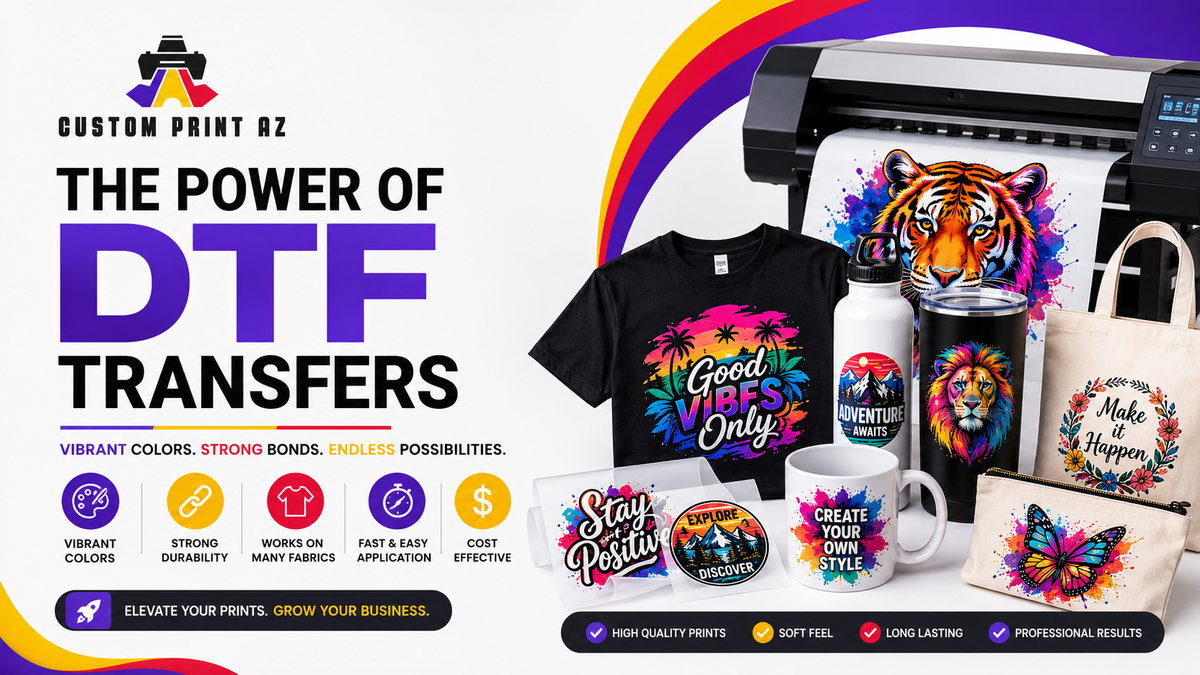
Direct-to-Film (DTF) transfers provide a transfer-based way to decorate custom apparel. Instead of printing directly onto the garment, the artwork is produced as a transfer and then applied to compatible apparel using heat and pressure.
This separation between transfer production and garment application can give businesses, apparel decorators, teams, and creators more flexibility when planning custom apparel projects. Understanding how DTF transfers work, however, is only the first step. Artwork quality, transfer size, garment compatibility, placement, and application requirements all affect the finished project.
What Are DTF Transfers?
DTF stands for Direct-to-Film. In a DTF production workflow, artwork is printed onto a transfer film and prepared with an adhesive layer. The completed transfer can then be positioned on a compatible garment and applied using the appropriate heat-press process.
Businesses that do not want to manage transfer printing themselves can order completed DTF transfers and focus on garment selection, placement, and application.
How Does the DTF Transfer Process Work?
Although production setups can vary, the DTF workflow generally separates the process into two stages: producing the transfer and applying the completed transfer to the garment.
Artwork Preparation
The process begins with the artwork. The design should be prepared at the intended print dimensions with sufficient image quality for the details that need to remain visible.
Small text, thin lines, fine details, transparent areas, and the overall proportions of the design should be reviewed before production.
Transfer Production
The prepared artwork is printed onto compatible transfer film as part of a DTF printing workflow. An adhesive layer is incorporated into the production process before the transfer is prepared for garment application.
Garment Application
The completed transfer is positioned on the garment and applied using heat and pressure. Application requirements can vary, so the instructions associated with the specific transfer and garment should be followed rather than assuming that one setting works for every project.
Why Do Businesses Use DTF Transfers?
One practical advantage of DTF is that transfer production can be separated from final garment decoration. A business can plan the graphics it needs and then apply those transfers to compatible garments according to its production schedule.
This can be useful for projects involving:
- branded business apparel,
- team and organization clothing,
- event apparel,
- merchandise,
- uniform projects,
- repeat designs, and
- multiple artwork variations.
The suitability of DTF still depends on the specific garment, artwork, placement, quantity, and application workflow.
Artwork Quality Matters Before You Order
A transfer cannot correct problems that already exist in the source artwork. Before submitting a design, review the file at approximately the size you intend to print it.
- Check that text remains readable.
- Inspect thin lines and small details.
- Confirm the final artwork dimensions.
- Remove unintended backgrounds when transparency is required.
- Check spelling and orientation.
- Avoid unnecessarily enlarging low-resolution artwork.
This review becomes especially important when the same artwork will be used at several different transfer sizes.
Choose the Transfer Size for the Garment
Transfer dimensions should be based on the usable print area of the garment rather than the artwork file alone. A design intended for a small left-chest placement has different sizing requirements from a large front or back graphic.
Consider collars, seams, pockets, zippers, garment edges, and other construction details that may affect the available application area.
When ordering individual graphics according to their dimensions, DTF Transfers by Size can help you plan the transfer around the intended placement.
Consider Gang Sheets for Multiple Graphics
Some projects require several logos, names, graphics, or repeated designs rather than a single transfer. In these cases, gang-sheet ordering can provide another way to organize artwork for production.
The important consideration is how the designs fit within the available sheet area. Artwork should be sized and arranged carefully before the final layout is submitted.
If your project contains multiple graphics, review the DTF Gang Sheet Builder option when planning your layout.
Garment Compatibility and Placement
Do not choose a garment solely because the artwork fits on it. The garment itself needs to be appropriate for the transfer and application process.
Before production, consider:
- garment material,
- garment construction,
- intended print location,
- available pressing area,
- transfer dimensions, and
- the required application instructions.
Test unfamiliar garment and transfer combinations before committing an entire production run whenever appropriate for your workflow.
Applying DTF Transfers
Heat, pressure, pressing time, peeling procedure, and any required finishing steps can affect transfer application. These requirements should come from the instructions associated with the transfer being used.
Avoid treating general settings found online as universal specifications. Different transfer systems, garments, and production workflows may require different application procedures.
Before starting a larger run, confirm that your heat press and garment setup can reproduce the intended placement and application consistently.
Planning for Repeat Apparel Orders
DTF projects become easier to reproduce when the production details are documented. If a design will be ordered again, keep a record of:
- the approved artwork file,
- transfer dimensions,
- garment style and size,
- print placement,
- order quantities, and
- the application process used for that transfer.
This creates a more repeatable workflow for uniforms, team apparel, branded merchandise, staff clothing, and other recurring projects.
Are DTF Transfers Right for Your Project?
DTF is one of several methods available for apparel decoration. The right choice depends on what you are producing rather than whether one printing technology is universally better than another.
Before ordering, ask:
- Is my artwork ready at the required print size?
- What garment will receive the transfer?
- Where will the design be positioned?
- What transfer dimensions do I need?
- How many different graphics are involved?
- Will I need the same artwork again?
- Do I have the appropriate application workflow?
If you are still comparing production methods, our DTF vs. screen printing guide provides a more focused comparison.
Explore DTF Transfers from Custom Print AZ
DTF transfers can support custom apparel workflows ranging from individual graphics to repeat production projects. The best results begin with appropriate artwork, sizing, garment selection, and application planning.
Explore Custom Print AZ DTF transfers and choose an ordering format that fits your artwork and production needs.

