

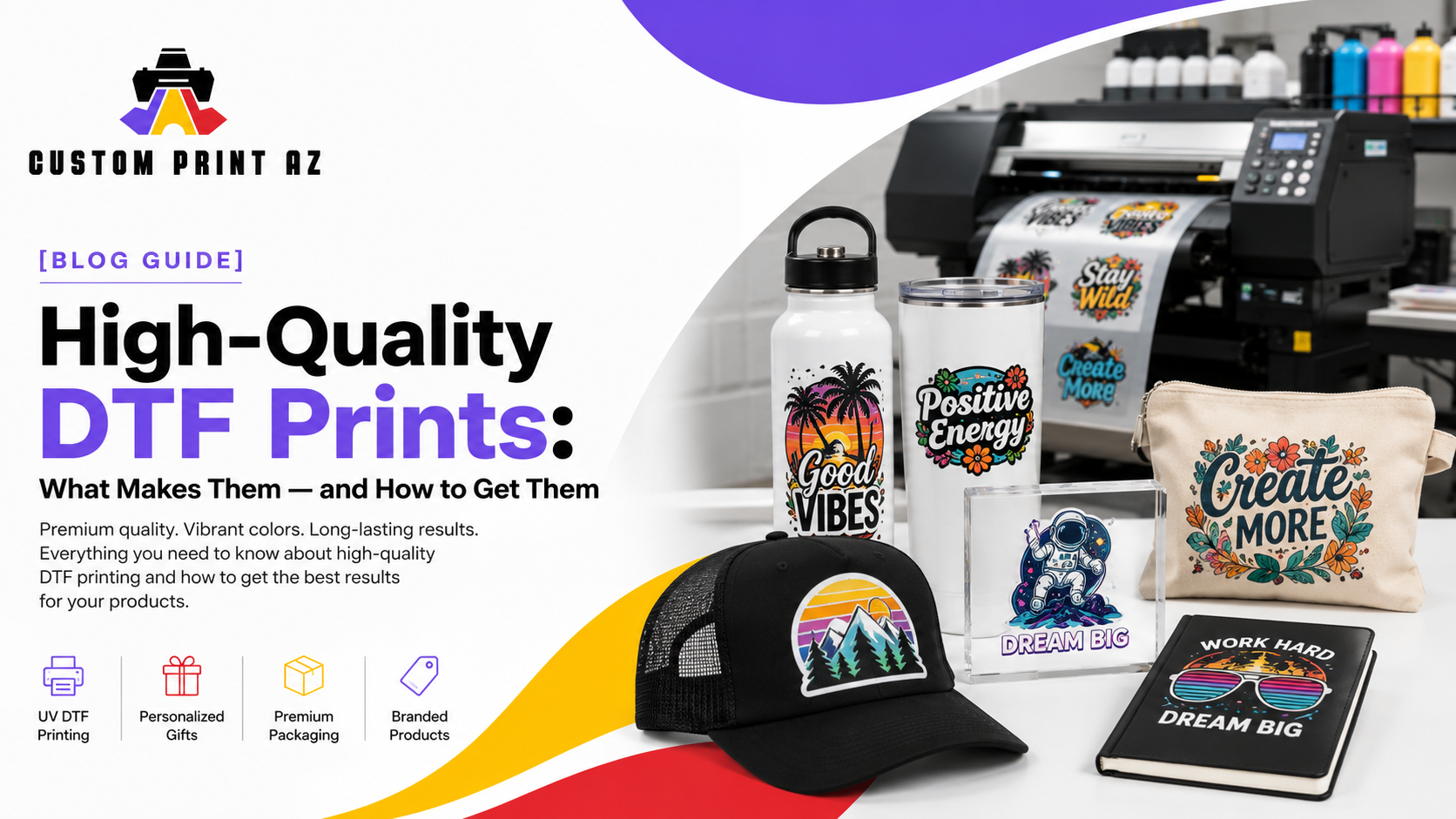
High-Quality DTF Prints: What Makes Them — and How to Get Them
High quality DTF prints should look bold on day one and still hold up after real wear, real washing, and real customer use. If you have ever ordered transfers that looked dull, showed through on black shirts, cracked after three washes, or felt like a stiff plastic patch, the problem was not “DTF” itself — it was the quality of the process.
This guide explains what separates a high-quality DTF print from a cheap one, the six factors that control DTF print quality, how to test a supplier before placing a bulk order, and how to order retail-grade transfers from Custom Print AZ without buying your own printer, powder station, curing oven, or RIP software.
The core idea is simple: print quality is not luck. It is the result of clean artwork, professional equipment, premium materials, calibrated curing, and correct heat-press application. When all six are controlled, DTF can produce vibrant, soft, durable transfers for brands, Etsy sellers, local events, teams, and small print shops.

What Counts as High Quality DTF Prints?
A high-quality DTF print is not just a transfer that looks good in a product photo. It should be vibrant, opaque, flexible, clean around the edges, and durable enough to survive repeated washing without cracking, peeling, or fading too early.
The easiest way to judge quality is to look at the result on the garment. Premium DTF prints should show bold solids, smooth gradients, accurate color, and a dense white underbase that keeps artwork bright on black, navy, red, green, and other dark fabrics.
Fine detail matters too. Small text, thin lines, hairline outlines, and clean transparent edges should press clearly without fuzzy borders or a white halo around the design. If a transfer loses detail before it even reaches the shirt, it is not a premium transfer.
Hand-feel is another major signal. A quality transfer should feel soft and flexible, not heavy or plasticky. The print should move with the garment, stretch slightly, and recover without cracking. Customers notice this immediately when they wear the shirt, hoodie, tote, or uniform.
For buyers, Etsy sellers, small apparel brands, and print shops, the real goal is simple: premium DTF prints that look retail-ready and hold up in the customer’s hands, not just on the production table.
DTF is popular because it works across many fabrics and order types. Compared with older decoration methods, it can handle full-color artwork, small runs, no minimums, and detailed designs without screens or vinyl layering. If you are still comparing print methods, this guide on what makes DTF different is a helpful companion.
What Makes a DTF Print High Quality? The 6 Factors
High quality DTF printing comes from controlling six technical factors: artwork, printer setup, film, white ink, adhesive powder, and heat-press application. Each factor affects the final look, feel, and durability of the print. If one factor is weak, the finished transfer suffers.
1. Artwork Resolution and File Prep
300 DPI artwork at full size is the starting point for a clean DTF print. Low-resolution logos, blurry screenshots, compressed JPEGs, and tiny web graphics usually print soft because the printer cannot invent detail that is not in the file.
Transparent PNG files and vector artwork are ideal when prepared correctly. The design should have clean edges, no unwanted background, and no stray semi-transparent pixels. Those invisible-looking pixels often become white halos after printing because the white underbase follows the artwork.
Good file prep also means sizing the artwork correctly before production. A logo prepared for a pocket print may not stay sharp when enlarged into a full-back graphic. The cleaner the file, the sharper the transfer.
2. The Printer, Printhead, and RIP Software
Professional DTF printers use quality printheads, controlled ink delivery, and properly profiled RIP software to manage droplet precision, color accuracy, white ink density, and layer order. The printer matters, but it is only one part of the full production system.
That is why the best results come from a complete workflow, not just a machine with impressive specs. A shop also needs calibrated color profiles, consistent maintenance, humidity control, clean film handling, and operators who know how to spot print defects before they reach the customer.
3. Premium PET Film
DTF film is the surface that carries the ink before the design is pressed onto fabric. Premium PET film with a matte-release coating holds ink cleanly, supports sharp edges, and helps the transfer peel correctly after pressing.
Cheap film can create smearing, dull color, uneven release, and inconsistent peel behavior. If the film cannot hold the printed layers cleanly, even strong artwork and expensive ink will not deliver a professional result. For production consistency, quality film is a must. You can learn more about premium DTF film and how it supports cleaner output.
4. White Ink Density
The white underbase is what makes color pop on dark fabric. Without enough white ink, reds look weak, yellows look muddy, and full-color artwork can appear dull or see-through once pressed.
More white is not always better, though. Too much white ink can create a thick, stiff, orange-peel texture that makes the transfer feel heavy. Professional shops tune white ink coverage in the RIP so the print gets strong opacity without losing flexibility. This is where premium DTF ink and accurate profiling make a major difference.
5. Adhesive Powder and Oven Curing
DTF adhesive powder is what bonds the printed design to the garment. The powder must coat the wet ink evenly, melt correctly, and cure at the right temperature. Uneven powder coverage can cause weak edges, rough texture, or early peeling.
Oven curing is just as important. Under-cured powder may not bond properly during the press. Over-cured powder can look greasy, feel rough, or create a weak final bond. A calibrated curing process — including the right DTF oven for high quality printing — helps produce consistent transfers across small and bulk orders.
6. Heat-Press Application
Even premium transfers can fail if they are pressed incorrectly. Time, temperature, pressure, peel timing, fabric type, and the second press all affect durability.
Custom Print AZ’s DTF application range is typically 280–320°F for 6–8 seconds with a warm peel, depending on the garment and transfer type. A short second press with a protective sheet helps lock the design into the fibers and improve wash durability.
For a deeper application guide, see how to get the best results with DTF transfers. It covers practical press settings and finishing steps that help professional DTF prints last longer.


Do You Need a High-Quality DTF Printer to Get High-Quality Prints?
No — you do not need to own a high-quality DTF printer to get high-quality DTF prints. A production-grade DTF printer can absolutely produce better, more consistent output than an entry-level setup, but the machine is only one part of the investment.
A serious setup usually includes the printer, quality printheads, RIP software, ink management, an automated powder shaker, a calibrated curing oven, ventilation, maintenance supplies, testing materials, and months of trial and error. That is why many people search for terms like high quality DTF printer 30cm price before realizing the real cost is bigger than the printer itself.
For most small businesses, Etsy sellers, event organizers, and apparel brands, the math is simple: ordering ready-made transfers gives you printer-grade results without buying equipment or learning production from scratch.
Custom Print AZ runs professional-grade equipment so you can focus on selling, pressing, and delivering finished products. You get the output without the overhead. Start with order high-quality DTF transfers by size if you have one design, or contact the team for free design assistance if your file needs cleanup before printing.
Not sure a supplier’s quality is real until you hold it? Order a free DTF + UV sample pack and run the black-shirt, stretch, and wash tests yourself — no risk.

How to Spot a High-Quality DTF Transfer vs. a Cheap One
You do not need to be a technician to spot high-quality DTF prints. A few simple tests can reveal whether a transfer is premium, average, or likely to fail after the customer washes it.
- The black-shirt test: Place the transfer on black fabric. Premium prints stay bright and opaque because the white underbase is dense enough. Cheap transfers often look dull, grey, or see-through.
- The edge test: Look closely at small text, thin lines, and transparent edges. Quality transfers have crisp borders with no fuzzy outline or white halo.
- The hand-feel test: Bend the pressed garment in your hands. A premium transfer should feel soft and flexible, not thick, stiff, or rubbery.
- The stretch test: Gently stretch a pressed sample. A strong transfer flexes and recovers. A cheap one starts cracking or separating.
- The wash test: The real proof is repeated washing. Premium DTF transfers can survive 50+ washes with proper care, while low-grade powder, weak curing, or poor pressing can fail quickly.
| What you’re checking | High-Quality DTF Print | Cheap DTF Print |
|---|---|---|
| Color on dark fabric | Bright and opaque | Dull or see-through |
| Edges and fine detail | Crisp, clean, no halo | Fuzzy edges or white outline |
| Hand-feel | Soft and flexible | Thick, stiff, plasticky |
| Stretch | Flexes and recovers | Cracks or separates |
| Wash durability | 50+ washes with proper care | Cracks, fades, or peels early |
The lowest-risk way to judge a supplier is to test the product before ordering in bulk. Order a sample, press it on a dark shirt, stretch it, wash it, and compare it against the checklist above.
This is especially helpful when comparing DTF to screen printing, DTG, HTV, or sublimation. Each method has strengths, but DTF stands out when you need full color, flexible ordering, and durable prints without large setup requirements. For more context, review how DTF compares to other printing methods.

Getting High-Quality Custom DTF Prints From Custom Print AZ
Once you know what quality looks like, the next step is choosing the easiest ordering path. Custom Print AZ gives you several ways to order high-quality custom DTF prints based on your file, order size, and workflow.
If you have one design and know the dimensions you need, order by size. This is ideal for pocket logos, left-chest prints, sleeve designs, full-front graphics, and full-back artwork.
If you have several designs, sizes, names, numbers, or repeated logos, the DTF Gang Sheet Builder helps you fit multiple graphics onto one sheet. Gang sheets lower your cost per print without lowering quality, making them a smart choice for brands, teams, events, and print-on-demand sellers.
If your gang sheet is already laid out, you can upload your ready-to-print gang sheet and move straight into production. For high-end drops, limited collections, and brand collabs, you can also explore Designer DTF transfers for high-end drops or browse premium DTF Transfers Zone.
Custom Print AZ focuses on professional-grade output with premium inks and film, no minimums, same-day shipping for qualifying orders placed by 2 PM, free design assistance, and local pickup in Phoenix. You can also learn more about Custom Print AZ and review the same-day shipping policy before you order.
The biggest advantage is speed without guesswork. You do not have to test powders, profile ink, troubleshoot nozzles, or waste film learning production. You send the artwork, choose the format, and receive transfers that are ready to press.

High-Quality DTF Prints in Bulk — Without Losing Quality
Scaling up should not mean sacrificing quality. With a controlled digital DTF workflow, print number 1,000 can match print number one because the same RIP profile, film, ink, powder, and curing process are used across the batch.
This is where gang sheets become especially powerful. You can place multiple graphics on one sheet, reduce waste, lower cost per print, and still keep the same color consistency and durability. For shops, schools, teams, reunions, local events, and POD sellers, gang sheets make bulk production more efficient without changing the print method.
Bulk DTF also helps small brands stay flexible. You can test a design with a short run, reorder winners, and avoid holding finished inventory in every size and color. Instead of printing hundreds of shirts upfront, you can keep transfers ready and press garments as orders come in.
That flexibility is one reason DTF is popular with Etsy shops and local apparel sellers. It supports small batches, personalized designs, seasonal drops, staff uniforms, sports teams, school events, family reunions, and business merch without the setup costs of traditional screen printing.
Keeping Your DTF Prints High Quality After Pressing
High-quality printing is only part of long-term durability. Wash care and application habits also affect how long the design looks fresh.
For best results, wash garments inside out in cold water on a gentle cycle. Tumble dry low or air dry when possible. Avoid bleach, harsh detergents, high-heat dryer settings, and ironing directly on the print.
The second press is one of the most underrated steps for longevity. After peeling, press the design again for about five seconds with a Teflon sheet or parchment cover. This helps smooth the surface, improve the hand-feel, and strengthen the bond between the transfer and the garment.
Fabric choice also matters. Cotton, polyester, and blends can all work well with DTF, but pressure, temperature, and dye migration risk may vary by garment. Dark polyester and performance fabrics can need extra attention because dyes may migrate into light-colored artwork if the wrong process is used.
With quality materials, correct pressing, and proper care, wash-durable DTF transfers can maintain vibrant color and crack resistance through 50+ washes.

FAQ
What makes a DTF print high quality?
A high-quality DTF print combines six factors: 300 DPI artwork, a professional printer and RIP profile, premium PET film, a dense white underbase, evenly cured adhesive powder, and correct heat-press application. The result is vibrant color, crisp detail, a soft hand-feel, and 50+ wash durability without cracking or peeling.
Are DTF prints good quality?
Yes — well-made DTF prints deliver vibrant full-color detail, a soft hand-feel, and excellent durability on cotton, polyester, and blends. Quality depends on the materials and process, not the method itself. Premium transfers from a professional service survive 50+ washes, while cheap transfers using low-grade powder and film crack early.
What is the best printer for high-quality DTF prints?
The best results come from professional DTF printers with quality printheads, properly profiled RIP software, and a calibrated curing oven. However, most small businesses do not need to buy one — ordering ready-made transfers from a service with professional-grade equipment delivers the same high-quality DTF prints without the equipment cost or learning curve.
How long do high-quality DTF prints last?
High-quality DTF prints last 50+ washes with proper care: wash inside out in cold water, tumble dry on low or air dry, and avoid bleach and high heat. Durability depends heavily on a dense white underbase, correctly cured adhesive, and a second press during application.
How can I test DTF print quality before ordering in bulk?
Order a sample first. Check it on black fabric for opacity, inspect the edges and fine detail, feel the hand-feel, gently stretch it for crack resistance, and wash a pressed sample. Custom Print AZ offers a free DTF and UV sample pack so you can test quality risk-free before a bulk order.
Do I need to buy a DTF printer to sell custom apparel?
No. Buying a production-grade DTF printer, oven, and powder station is a major investment that takes weeks to calibrate. Most sellers get better results faster by ordering ready-to-press transfers from a professional service — printer-grade quality, no overhead, no minimums, and same-day options.
Where can I get high-quality DTF prints near me in Phoenix?
Custom Print AZ provides high-quality custom DTF prints in Phoenix, AZ, with same-day shipping for orders placed by 2 PM, no minimums, and local pickup at 3411 E Corona Ave #108. Order by size, build a gang sheet, or upload a ready-to-print file.
Order Retail-Grade DTF Prints Without the Guesswork
High-quality DTF prints come down to six controllable factors: clean artwork, professional printing, premium film, correct white ink density, properly cured adhesive powder, and accurate heat-press application. When all six are dialed in, the result is vibrant, flexible, wash-durable, and ready for real customers.
The easiest way to get all six right is to work with a print service that already has the workflow built. Custom Print AZ helps Phoenix businesses and nationwide customers order retail-grade DTF transfers with no minimums, same-day options, 50+ wash durability, and free design help.
Skip the printer, the oven, and the months of calibration — order retail-grade DTF prints from Custom Print AZ’s Phoenix print shop with same-day shipping and no minimums.


