

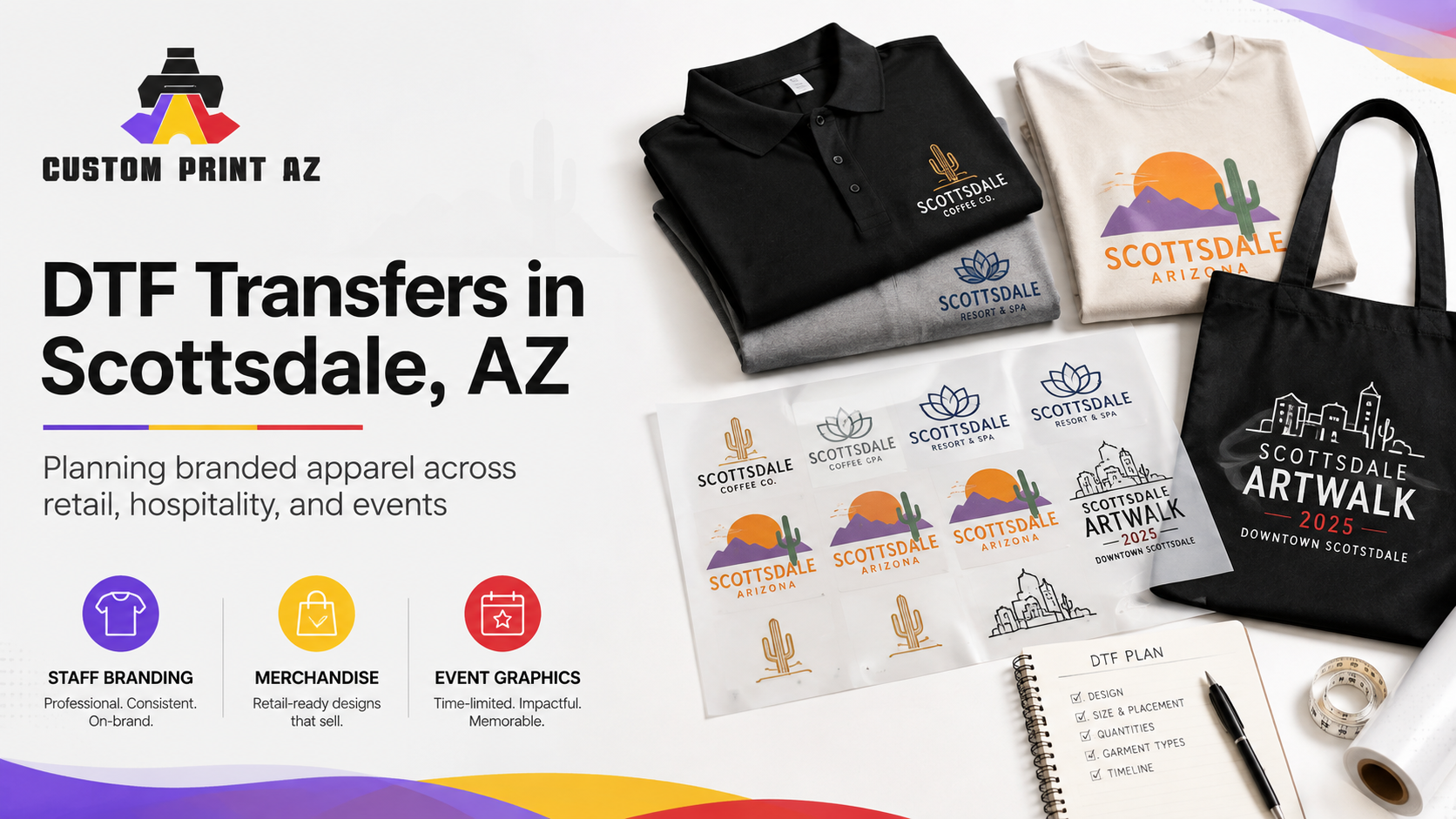
Planning DTF transfers for a Scottsdale business should start with a simple question: what job will the finished apparel actually do? Everyday staff apparel, visitor-facing merchandise, and short-lived event graphics can all use DTF transfers, but they should not automatically follow the same artwork, quantity, or reorder plan.
For businesses that already know what they need, the fastest path is to review the available DTF transfer options. If the order still needs planning, separating apparel by its role and expected life cycle can make the next decisions much clearer.
Why Branded Apparel Demand in Scottsdale Is Not One-Size-Fits-All
Scottsdale has an unusually varied mix of visitor-facing and local business activity. City tourism materials describe Old Town as a center for shopping, dining, culture, nightlife, community gatherings, and other visitor activity. That mix creates different apparel needs within the same local economy.
A restaurant or hospitality business may need long-running brand apparel for its team. A retailer may manage merchandise intended for customers. A gallery, venue, or local organization may need graphics tied to a particular program or event. In some cases, one business may manage more than one of these uses at the same time.
The size of Scottsdale's visitor economy makes that distinction worth taking seriously. The City of Scottsdale's visitor research estimated that domestic visitors spent about $1.97 billion in the city in 2024. That figure is not a measure of DTF demand, but it does show why customer-facing retail, dining, lodging, recreation, and entertainment are meaningful parts of the local business environment.
Instead of treating every design as identical inventory, start by deciding whether each graphic is a long-term brand asset, a customer-facing merchandise design, or a time-limited campaign or event asset.
Define the Job of the Apparel Before You Define the Order
Quantity decisions become easier when the role of the apparel is clear. The same transfer technology can support several workflows, but the risk of over-ordering, under-ordering, or reusing outdated artwork changes with the purpose of the design.
Core Brand and Staff Apparel
A primary logo, established brand mark, or other design used continuously by a business is relatively stable. These graphics may appear on staff shirts, customer-facing team apparel, or other recurring branded pieces.
For this type of work, the important planning questions are usually:
- Which artwork file is the approved production version?
- What physical print dimensions should remain consistent?
- Where will the design be placed on the garment?
- How many transfers are needed for the current run?
- Is the same artwork likely to be reordered later?
The goal is not to create unnecessary inventory. It is to preserve decisions that should remain consistent so the next production run does not have to recreate the setup from memory.
Visitor-Facing Merchandise
Merchandise creates a different decision. A design may be connected to the business for a long time, or it may be created for a shorter retail opportunity. The important question is not only whether a graphic is ready to print, but also how long the design is expected to remain useful.
That distinction matters in a market with substantial retail and visitor activity. U.S. Census Bureau data reports approximately $11.63 billion in Scottsdale retail sales for 2022. Customer-facing merchandise is only one small part of that broader economy, but the local retail scale supports treating merchandise planning as a real business workflow rather than an occasional exception.
Separate evergreen brand designs from seasonal, promotional, or limited-use graphics before deciding how many transfers to produce. A core logo may remain usable across multiple runs, while a dated promotion may lose value as soon as the campaign ends.
Event and Campaign Apparel
Event apparel usually has a harder expiration date. A design that includes an event identity, sponsor lineup, date, campaign message, or temporary theme may have little use once that specific moment has passed.
Scottsdale recognizes special events as part of the city's tourism and community environment. For an apparel buyer, the practical takeaway is straightforward: event-driven graphics need a different production timeline from permanent brand graphics.
Artwork approval, quantity confirmation, transfer ordering, garment preparation, pressing, quality checks, sorting, and final distribution all have to fit inside the usable window. Ordering more transfers does not create more time, and ordering early does not help if the artwork is still likely to change.
How Stable Is the Artwork, and How Variable Is the Demand?
A useful way to plan a Scottsdale DTF order is to evaluate two things together: artwork stability and demand variability.
Stable artwork with stable demand can support a repeatable production setup. The design changes rarely, and usage is reasonably consistent.
Stable artwork with variable demand requires a different approach. The logo may stay the same, but the quantity needed from one period to another can change.
Changing artwork with a fixed deadline is common in event or campaign work. The delivery date may be known even while the design is still moving through approval.
Changing artwork with uncertain demand creates the greatest inventory risk because both the design life cycle and the final usage quantity are less predictable.
This framework changes the main ordering question from “How many transfers can we order?” to “How long will this artwork remain valid, and how predictable is the demand for it?”
Choose a DTF Order Format That Fits the Workflow
Once artwork roles, dimensions, and quantities are clearer, the next decision is how the transfers should be ordered. Different projects may benefit from different formats, and a business does not need to force every job into the same workflow.
DTF Transfers by Size
Best suited for: Projects where individual designs and physical print sizes are already defined.
What to define first: Final artwork, actual print dimensions, and required quantity for each design.
When designs are easier to manage as individual transfers, DTF transfers by size provide a direct path from approved artwork to a clearly defined order.
This approach can be useful when a business wants each transfer specification to remain easy to identify without building a multi-design sheet workflow.
Upload a Gang Sheet
Best suited for: Buyers who already have a completed gang sheet layout prepared for production.
What to define first: The active artwork versions, final physical dimensions, required quantities, and finished sheet layout.
The DTF Upload Gang Sheet route makes sense when the layout itself is already part of the buyer's production workflow.
Efficiency should not be measured only by how much artwork can be squeezed onto a sheet. A useful gang sheet should also be practical to identify, cut, sort, and move into pressing. Businesses preparing their own layouts can review the existing gang sheet preparation guide before finalizing the file.
Build a Gang Sheet
Best suited for: Buyers who want to organize multiple transfer graphics using an online builder rather than uploading a finished sheet.
What to define first: Which designs belong in the production batch, their dimensions, and the approximate quantity relationship between them.
The DTF Build Gang Sheet option can help organize several graphics into one layout workflow.
The important step happens before the layout is filled: decide which designs actually belong together. A permanent staff logo and a short-lived event graphic can appear in the same production order, but they should still remain separate assets in the business's artwork system.
Plan Quantity and Deadline Together
Quantity and timing should not be treated as separate decisions. A small order can create a fast reorder need, while an oversized order can leave a business holding transfers for artwork that is no longer relevant.
Before setting quantity, ask three questions:
- How long is this artwork expected to remain usable?
- How long should the current quantity reasonably support the business?
- If the design changes, would the remaining transfers still have a purpose?
For permanent branding, a future reorder may be straightforward because the artwork is likely to remain active. For a promotion or event, unused transfers can become obsolete much sooner.
The production deadline should also include what happens after the transfers are received. Garment preparation, pressing, first-piece review, quality control, sorting, packing, and final handoff may all require time. If there is a hard customer or event deadline, work backward from the finished-apparel date rather than treating transfer receipt as the end of production.
If a particular fulfillment method is important to the schedule, confirm the currently available options when the order is placed rather than building the entire production plan around an assumption.
How the Business Type Changes the Planning Decision
Scottsdale's local economy reinforces the need for different apparel strategies. U.S. Census Bureau data reports about $3.06 billion in accommodation and food services sales in 2022 in addition to the city's substantial retail activity. Those numbers do not indicate DTF spending, but they confirm that retail and hospitality are major parts of the local commercial environment.
A retailer may need to separate permanent brand merchandise from designs tied to limited promotions or visitor seasons.
A hospitality business may manage durable staff branding alongside customer-facing merchandise or temporary promotional apparel.
A gallery, cultural venue, or attraction may need to distinguish the organization's permanent identity from artwork related to a particular exhibition, program, or event.
An event-connected business or organization may have a firm usage date that makes artwork approval and quantity confirmation more important than maintaining a large transfer inventory.
The DTF process may be similar across these uses. The production plan should not be.
What Should Stay Consistent for Repeat Orders?
A repeat order works best when permanent information is separated from information that should be reconsidered every time.
Approved core artwork, confirmed transfer dimensions, and standard placement references may be worth preserving as reusable production information. Quantity, garment mix, campaign graphics, dates, event identities, and customer-specific variations may need to be reviewed on every order.
This is particularly useful for businesses that regularly press the same brand graphics. A documented setup can reduce unnecessary decision-making while still allowing the quantity and garment mix to respond to current demand. Businesses considering this kind of workflow can also review how ready-to-press DTF transfers fit repeat production.
Clear file naming matters as well. Names such as “final,” “final-new,” and “final-2” make it difficult to know which version is actually approved. The production master should be obvious, while retired or campaign-specific files should remain clearly separated from active artwork.
How Do You Know the Order Is Ready?
Before moving a DTF project into production, confirm that:
- The active artwork version has been approved.
- Evergreen and campaign-specific artwork are clearly separated.
- The physical print dimensions are defined.
- Garment placement has been decided.
- Quantity is defined for each design and size variation.
- The order format matches the artwork and quantity structure.
- The deadline includes pressing and finishing time.
- Repeat-use artwork is documented for future orders.
- Short-lived graphics are not being treated as permanent inventory.
- Any critical fulfillment requirement has been confirmed before production planning is finalized.
If these decisions are clear, the project is much closer to a production-ready order rather than simply a collection of printable files.
Common Questions About DTF Transfer Planning in Scottsdale
Should staff apparel and event merchandise be planned as one order?
Not automatically. They may be produced at the same time, but their artwork life cycles can be very different. A core staff logo may remain useful for future orders, while event artwork may become outdated immediately after a specific date. Evaluate quantity and future usability separately before combining the production plan.
Why should core logos and campaign graphics be managed separately?
Core logos are more likely to remain active across repeated production runs. Campaign graphics may be tied to a temporary promotion, sponsor, date, or seasonal message. Keeping the assets separate reduces the chance that an outdated design will be reordered as though it were still current.
If an order has several designs, should it always use a gang sheet?
No. The number of graphics is only one factor. Physical dimensions, quantities, layout readiness, cutting and sorting needs, and whether the designs logically belong in the same batch should also influence the decision. A gang sheet is useful when it improves the overall workflow, not simply because several files exist.
Should a Scottsdale business keep extra DTF transfers for future use?
That depends on the artwork and demand. Extra transfers for an established core logo may remain useful if the design and dimensions are stable. Extra transfers for a dated campaign or temporary event can become unusable quickly. Decide based on artwork life span and realistic repeat demand rather than using one inventory rule for every design.
Move From Planning to Production
The most useful DTF workflow is not the one that treats every project the same. It is the one that matches the artwork, quantity, format, and deadline to the real job the apparel needs to perform.
For Scottsdale businesses, that can mean separating permanent staff branding from visitor-facing merchandise and time-limited event graphics, then choosing the appropriate production route for each. Once the artwork life cycle, dimensions, quantity, and deadline are clear, the order itself becomes much easier to organize.
When those decisions are ready, Custom Print AZ provides the next step for turning approved artwork and a defined production plan into a DTF transfer order.


