

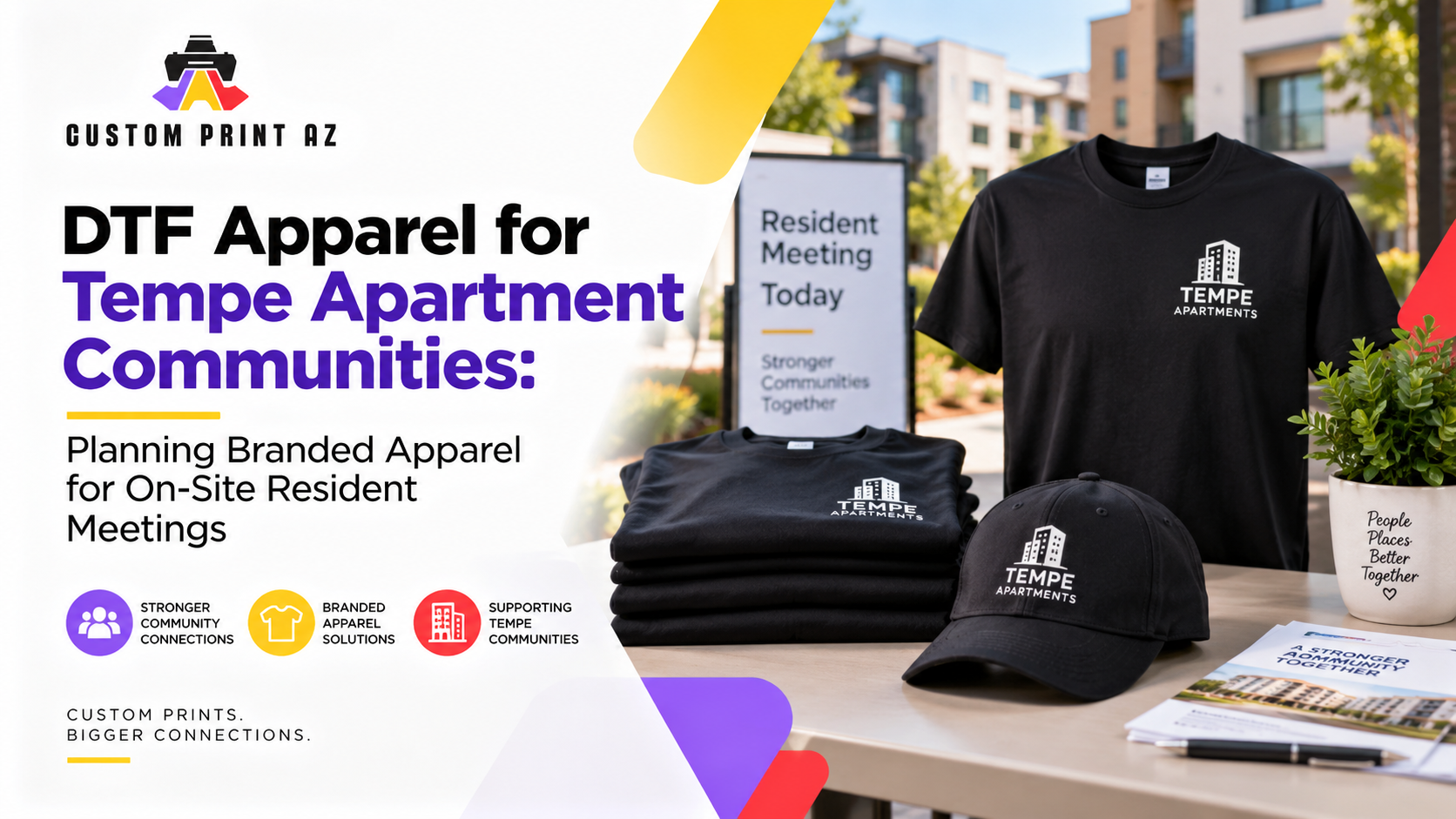
When a Tempe apartment community is preparing for a resident meeting, branded apparel does not have to start with a new design or a new shirt order. If the property already has approved logo artwork or staff apparel, the better first question is simpler: does the existing branded apparel already work for this meeting?
There is a real local context for this question in Tempe. The City of Tempe's Crime Free Multi-Housing program includes several stages involving apartment-community personnel. The program describes training for property management and facilities staff, an on-site assessment involving the property manager, and an on-site crime-prevention meeting where property management and Tempe Police invite residents to participate.
The program does not require branded apparel or recommend DTF printing. What it does provide is a useful Tempe-specific example of property-management teams interacting with residents in an on-site setting. When a community decides that branded apparel makes sense for that type of resident-facing use, the apparel decision should come from the actual need rather than from the fact that a meeting is happening.
A practical way to make that decision is to choose among three paths: reuse existing property apparel, modify how approved artwork is applied to a new garment, or create meeting-specific apparel only when the meeting genuinely calls for something different.
Start by Deciding Whether Existing Property Apparel Is Enough
A resident meeting should not automatically trigger a new apparel order. If the property already has approved logo artwork and usable branded apparel, review what is available before creating anything new.
Existing apparel may already do the job when the goal is simply to represent the apartment community consistently in a resident-facing setting. A property logo that is already used on staff apparel does not become unsuitable just because the team is participating in a different meeting.
This distinction matters when the meeting itself does not have a separate campaign, program, or visual identity. If the apparel only needs to carry the property's established branding, introducing another graphic can add a design decision without solving a new problem.
Before ordering, property managers can look at the apparel they already have and ask whether it is appropriate for the planned setting, whether the approved artwork is still the correct version, and whether enough usable garments are available for the people who will actually wear them.
If the answers are yes, a new DTF project may not be necessary at all. That is a valid planning outcome.
Know When Existing Artwork Needs a Different Application
Sometimes the property artwork is still correct, but the apparel requirement changes. This is different from creating a new design.
For example, moving approved artwork to a different garment does not necessarily mean that the previous transfer dimensions and placement should be copied without review. A different garment can provide a different usable print area, and artwork that looked balanced in one application may need to be evaluated again in another.
When preparing DTF transfers, the artwork should therefore be considered together with the garment and intended print area rather than as an isolated digital file.
The goal is not to redesign the property logo. The goal is to make sure the approved brand artwork is being applied appropriately to the apparel selected for the meeting.
Before moving forward, confirm:
- which approved artwork file will be used,
- which garment will receive the transfer,
- what print area is available on that garment,
- what the final transfer dimensions should be, and
- where the artwork should be placed.
This creates an important distinction for property managers: keeping the brand consistent does not require every physical apparel specification to remain identical.
Ask Whether Meeting-Specific Apparel Is Actually Necessary
The fact that a resident meeting has a name, date, or specific purpose does not mean those details belong on a shirt.
Before adding meeting-specific information to apparel, separate evergreen property branding from information that only matters for one meeting.
A property logo can remain useful across multiple resident-facing situations. A meeting date, meeting title, temporary message, or one-time graphic has a much narrower use. Adding temporary information can turn otherwise reusable branded apparel into something tied to a single occasion.
That may be appropriate when a meeting is part of a genuinely distinct initiative with its own apparel need. But it should be a deliberate decision rather than the default approach.
Property managers can ask one practical question: Does this information really need to be on the apparel, or does our existing property branding already accomplish what we need?
If the existing branding is sufficient, there is little reason to make the apparel more complicated. If the meeting truly requires a separate graphic, that graphic can be treated as a distinct design decision instead of being mixed into the property's core brand artwork.
Do Not Turn Resident Headcount Into Shirt Quantity
Another easy planning mistake is treating meeting attendance as apparel quantity.
The number of residents expected at a meeting and the number of branded garments needed for property personnel are two different numbers. Residents may be the audience for the meeting, but that does not make them part of the staff apparel count.
Instead, determine who will actually wear the branded apparel. Once that group is defined, calculate the garment requirements for those people.
This becomes especially useful when attendance estimates change. A larger resident turnout does not automatically require more staff shirts. Likewise, the apparel quantity should not be increased simply because the meeting itself grows.
Keeping these two counts separate prevents an event-planning number from becoming an apparel-ordering number without a clear reason.
Do Not Automatically Use One Transfer Specification on Every Garment
Consistency is valuable in property branding, but consistency does not mean copying every production detail from one garment to another.
The approved property logo can stay the same while the physical application changes. Different garments can have different usable print areas, proportions, seams, or other placement considerations. That means the final transfer size should be evaluated for the garment that will actually be used.
A property manager does not need to make this process complicated. The important point is simply to avoid assuming that an old transfer specification is automatically correct for a new apparel choice.
Review the artwork at its intended final dimensions and consider how it will sit within the available print area. If a new garment changes the application, adjust the production specification while keeping the approved property identity intact.
Use a Simple Reuse, Modify, or Create Decision
Property managers can simplify the entire resident-meeting apparel decision by placing the project into one of three categories before ordering.
- Reuse: Existing property-branded apparel already fits the meeting and no new production is necessary.
- Modify: The approved property artwork remains appropriate, but the garment, transfer dimensions, placement, or other application details need to be reviewed for the new use.
- Create: The meeting has a genuine apparel need that cannot be handled by existing property branding, so separate meeting-specific artwork should be considered.
This sequence helps prevent the process from jumping immediately to the third option.
For many resident-facing situations, the answer may be reuse. In others, the property may only need to modify the physical application of existing artwork. Creating new meeting-specific apparel becomes the choice only when there is a clear reason for the meeting to have a separate visual treatment.
That keeps the artwork decision connected to the actual operational need.
Check the Apparel Plan Before Ordering DTF Transfers
Once the property has decided whether to reuse, modify, or create, the remaining order preparation becomes more concrete.
For a Tempe apartment community considering new branded apparel for an on-site resident meeting, a final pre-order review can include:
- Review the property-branded apparel that already exists.
- Decide whether new apparel is actually needed.
- Confirm the approved property artwork that will be used.
- Decide whether meeting-specific artwork has a real purpose.
- Select the garment that will receive the artwork.
- Review the available print area.
- Confirm the final transfer dimensions and placement.
- Count the people who will actually wear the branded apparel.
- Review the final artwork and production details before ordering.
This checklist also helps keep branded apparel within its proper role. A logo shirt should not be treated as a substitute for protective workwear, PPE, a security credential, or any official identification that may be required for a particular job or situation. Those requirements should be handled separately from the branding decision.
Every Resident Meeting Does Not Need to Become a New Apparel Project
The most useful apparel plan for a Tempe apartment community may sometimes be the decision not to create anything new.
If existing property-branded apparel already fits the resident-facing setting, reuse it. If the artwork is still right but the garment application has changed, review the production details without rebuilding the brand. If the meeting genuinely has a separate apparel purpose, then consider creating something specifically for it.
This approach keeps the order connected to a real apparel requirement instead of treating every resident meeting as a reason to produce another design.
By making the reuse, modify, or create decision first, property managers can approach a DTF order with clearer answers about artwork, garments, transfer dimensions, placement, and quantity. The result is a simpler planning process built around what the apartment community actually needs for the meeting.


