

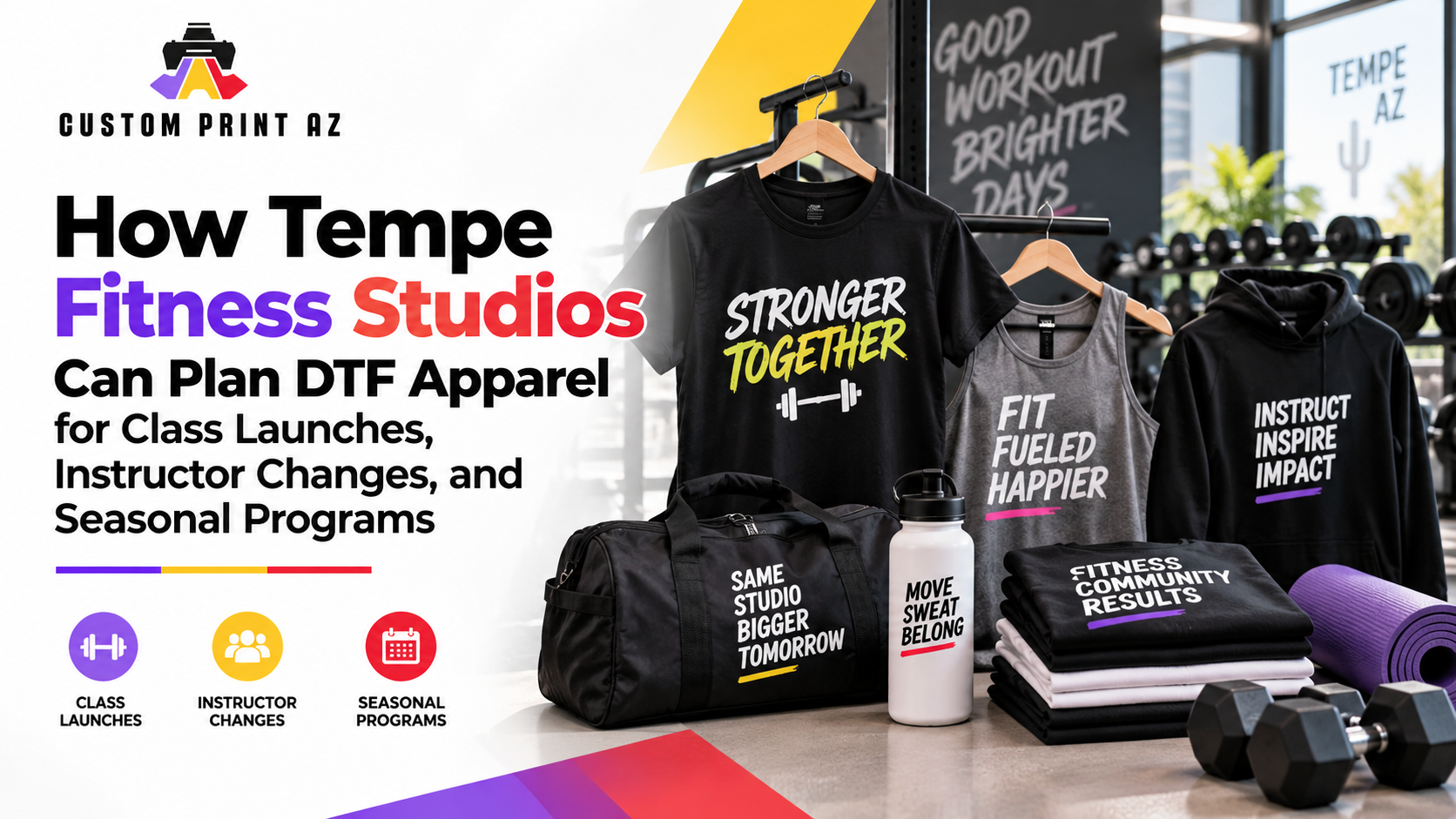
A fitness studio does not become a different brand every time a new class launches. Its logo, core visual identity, and recognizable apparel can stay consistent even while instructors change, class formats evolve, and seasonal programs come and go.
Problems can start when those permanent and temporary elements are managed as one apparel system. A new class suddenly means new artwork. An instructor change triggers another redesign. A seasonal program creates transfers that may have little use after the program ends. Over time, the studio can accumulate overlapping files and inventory without a clear reason for each variation.
A more practical approach is to separate stable studio identity from the changing program layer. For Tempe fitness studios using DTF transfers, that means deciding what should remain reusable before creating artwork for the next class launch, instructor change, or seasonal program.
There is a real local context for program-based fitness activity. The City of Tempe operates four fitness centers within its Community and Recreation Centers and offers multiple types of fitness programming. Its sports and fitness programming includes activities such as yoga and martial arts alongside other exercise options. That does not measure the number of commercial studios in Tempe, but it does demonstrate that class- and program-based fitness is part of the local recreation environment.
Start by Separating Studio Identity From Program Identity

Before asking what shirt a new class should have, determine which parts of the artwork belong to the studio itself and which exist only because of a particular program.
Stable studio identity can include the primary logo, a recurring brand mark, an established placement, or another design that remains useful regardless of who teaches a class. These are assets the studio may be able to use across instructors and programming cycles.
The changing program layer includes graphics that make sense only for a particular class launch, seasonal challenge, short-term campaign, or other limited program. A design containing a program name, year, season, or temporary message does not necessarily have the same useful life as the studio logo.
This distinction does not mean every studio needs multiple apparel systems. It means temporary changes should remain temporary instead of forcing changes to branding that was already working.
For a New Class Launch, Ask Whether the Core Design Is Already Enough
A new class does not automatically require new apparel artwork. The first decision should be whether the class actually needs to look different from the rest of the studio.
If a new format is simply another part of the existing studio experience, instructors may be able to use the established studio design. Keeping the same core artwork can also preserve previously approved dimensions and placement instead of creating another production variation solely because the schedule has changed.
A program-specific graphic becomes more relevant when the class has a distinct customer-facing identity, a defined campaign period, or another reason to be visually differentiated.
Before creating that variation, consider:
- Does the class name need to appear on the apparel for the design to serve its purpose?
- Will the artwork still make sense after the launch period?
- Would instructors reasonably wear the apparel outside this specific class?
- Is the program expected to return in another season?
- Would the existing studio logo accomplish the same branding goal?
The goal is not to avoid new designs. It is to make sure a new production asset exists because the program needs it, not simply because the class is new.
Do Not Let an Instructor Change Automatically Trigger an Apparel Redesign
Instructor rosters can change more frequently than a studio's core brand. That makes instructor identity an important checkpoint in the apparel planning process.
Suppose a studio uses the same logo, transfer dimensions, and placement for its instructors. When one instructor leaves and another joins, the underlying design may not need to change at all. The new decision may simply be how many additional pieces or transfers are actually required.
The situation is different when artwork includes an instructor's name, personal branding, individual slogan, or another person-specific element. Those graphics have a shorter lifecycle because their usefulness depends on that instructor remaining connected to the program.
Separating these two cases prevents a personnel change from becoming a complete artwork reset. The studio can keep its reusable identity intact while updating only the layer that genuinely depends on the instructor.
Plan Seasonal Artwork Around Its Useful Life
Seasonal programs introduce another planning question: how long will this artwork remain relevant?
A studio may run a summer challenge, a limited training series, a holiday program, or another class with a defined beginning and end. A graphic created specifically for that program can be useful while the program is active, but leftover transfers containing a season, year, or one-time program name may be difficult to use later.
That makes quantity planning different from the decision for a permanent studio logo. Extra core-logo transfers may remain useful for a future instructor or another recurring apparel need. A highly specific seasonal graphic may not have the same flexibility.
Before increasing quantity for a temporary design, consider the expected number of users, how frequently the apparel will be needed, whether replacements are likely, and whether the exact artwork can realistically return in another program cycle.
This keeps the quantity decision connected to the artwork's lifecycle instead of treating every design as permanent inventory.
Separate Instructor Needs From Member Merchandise Demand
A studio can use the same branding across instructor apparel and member merchandise, but that does not mean both uses should share the same quantity decision.
Instructor needs can often be estimated from the active roster and the way the apparel will be used. Member merchandise depends on a different factor: actual customer demand.
A class graphic may make sense on instructor apparel because it helps represent the program, while producing a larger member-facing quantity may be unnecessary unless there is a reason to expect demand. Conversely, a strong recurring studio design may have a useful life beyond a single class.
When planning DTF transfers for apparel, keeping these quantities separate makes it easier to avoid turning an operational instructor need into an unsupported merchandise forecast.
Preserve the Core Production Information That Can Be Reused
Reusable branding is more than keeping the original logo file. A studio can also preserve the production information that makes a proven design easier to reorder consistently.
For core artwork, useful records may include:
- the approved artwork version,
- final transfer dimensions,
- front, back, or other placement information,
- the intended apparel application,
- which design is the core studio version,
- which variations belong only to a class, instructor, or temporary campaign.
This does not require an elaborate asset-management system. A simple distinction between reusable core artwork and temporary variations can prevent the wrong file from becoming the starting point for the next order.
It is also important to separate reusable specifications from reusable quantities. The same dimensions and placement may work again while the required number of transfers changes because the instructor roster, program size, or merchandise demand is different.
Make the Quantity Decision After the Artwork Lifecycle Is Clear
Quantity is easier to evaluate once the studio knows what kind of artwork it is ordering. Otherwise, permanent and short-lived designs can accidentally be treated as if they carry the same inventory risk.
A useful decision sequence is:
- Identify the stable studio identity. Which artwork should remain useful even when classes or instructors change?
- Identify the changing program layer. Which artwork exists only because of a particular launch, season, or campaign?
- Check the instructor need. Does an instructor change actually require different artwork, or only a different quantity?
- Set quantity according to useful life. Do not apply the same inventory assumptions to reusable and short-lived graphics.
- Prepare for the reorder. Keep the approved artwork, dimensions, and placement available for the next relevant use.
This creates a repeatable planning model: stable studio identity → changing program layer → instructor need → quantity decision → reorder readiness.
Use a Short Apparel Brief Before the Next Class Launch
Before sending the next design into production, a studio owner, manager, or program coordinator can answer a short set of questions. This is especially useful when several classes or instructors share parts of the same branding.
- Is this core studio artwork or a program-specific variation?
- Would the design remain usable if the instructor changed?
- Is it intended for instructors, member merchandise, or both?
- How long is the artwork expected to remain relevant?
- Are the final dimensions and placement already established?
- What quantity is supported by the current need?
- Would leftover transfers remain usable after the program ends?
Once those decisions are clear, the studio has a better basis for deciding which artwork and specifications should be used for custom DTF transfers without treating every new program as a complete restart.
Frequently Asked Questions
Does every new fitness class need a new apparel design?
No. If the class is an extension of the existing studio identity, the core logo or established branded artwork may already serve the purpose. A separate program graphic is more useful when the class genuinely needs its own visual identity or campaign-specific message.
Can a studio reuse DTF artwork after an instructor changes?
If the artwork is based on the studio's core branding and does not contain instructor-specific information, an instructor change may not require new artwork. The studio can instead evaluate the quantity needed for the incoming instructor while keeping the approved core specification.
Should seasonal fitness program artwork include the year or season?
Only when that information adds meaningful value to the program. Adding a year, season, or one-time campaign reference makes the design more specific and can reduce the usefulness of leftover transfers after the program ends.
Should instructor apparel and member merchandise use the same quantity plan?
Not automatically. Instructor quantity is connected to roster and operational use, while member merchandise depends on customer demand. The same artwork can serve both groups without requiring the same inventory decision.
What should a fitness studio keep for future DTF reorders?
Keep the approved core artwork version, final transfer dimensions, placement information, and a clear record of which variations were temporary. Previous usage can provide context, but quantity should still be reassessed for the next class, instructor roster, or program.
Keep the Studio Brand Stable and Let the Program Layer Change
Fitness programming is designed to change. New classes can launch, instructors can move in and out of the schedule, and seasonal programs can have short lifecycles. The studio's core apparel system does not need to change at the same pace.
By separating permanent studio branding from instructor- and program-specific artwork, Tempe fitness studios can preserve reusable production information while making temporary decisions only where they are actually needed.
The practical goal is a system in which a class launch does not automatically require a redesign, an instructor change does not invalidate the studio's core artwork, and a short seasonal program does not create more specialized inventory than its useful life supports. With that structure in place, the next reorder starts from a known foundation instead of starting over.


