

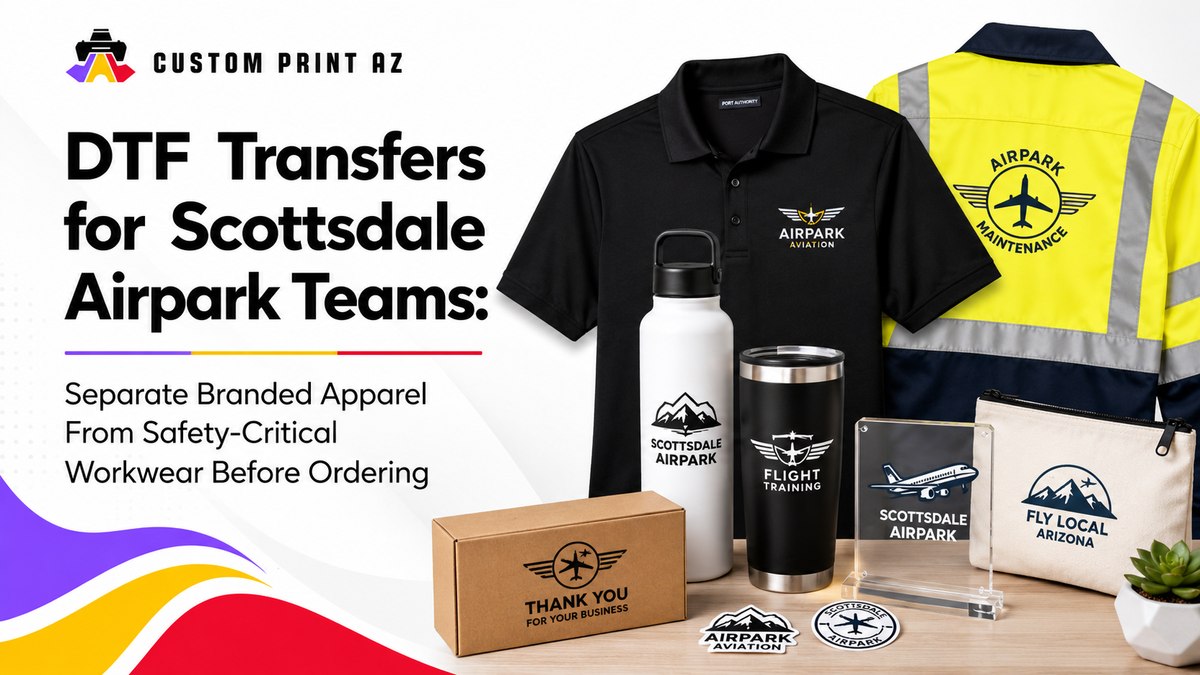
A company's employee apparel list can include polos, customer-facing staff shirts, office layers, and operational work garments at the same time. On an order sheet, they may all look like variations of “employee clothing.” For decoration planning, however, treating every garment as one category is not a good starting point.
Before preparing a DTF transfer order, ask a more fundamental question: Has this garment been confirmed by the employer as ordinary, non-protective branded apparel, or does its workplace role involve a protective, safety-related, or otherwise controlled function that needs separate verification?
That distinction should happen before choosing logo placement, calculating transfer quantities, or finalizing the order. If there is any indication that a garment may serve a protective or safety-critical role, it should not automatically enter the same decoration workflow as ordinary branded apparel.
Do Not Treat “Employee Apparel” as One Category
People working for the same company do not necessarily have the same apparel needs. One team may wear shirts or polos primarily for customer-facing branding, while another works in a different operational environment.
The important question is not what the garment is called. It is how the garment is actually used at work.
Instead of building the order list around size and quantity alone, identify the role of each garment first. The initial list might distinguish among:
- Garments the employer has confirmed as ordinary branded apparel
- Normal branded layers used for customer-facing or office purposes
- Garments used in operational environments that require additional review
- Protective, safety-related, or otherwise controlled garments that require separate verification
The last two groups should not move directly into the decoration list. Their actual workplace role and any applicable safety requirements need to be understood first.
Scottsdale Airpark Shows Why This Is a Real B2B Planning Issue
The City of Scottsdale's Airport/Airpark general information describes the Airport and surrounding Airpark as major employment sources and reports nearly 3,233 small and medium-sized businesses with more than 59,000 employees in the Airpark area. The page was last updated May 13, 2026. :contentReference[oaicite:0]{index=0}
The city's Airport/Airpark business directory also shows a wide mix of activities in the area, including aircraft charter, flight training, aircraft maintenance and repair, and mobile aircraft washing. :contentReference[oaicite:1]{index=1}
That does not mean these businesses use DTF transfers, nor does it establish that particular employees use PPE. It does illustrate the broader operational point: in an employment district with many different business activities, putting every employee garment under a single “company shirt” label may hide meaningful differences in how those garments are used.
For decoration planning, a cleaner approach is to separate garments by their actual use rather than relying only on department names or general uniform categories.
Ordinary Branded Apparel Should Be Confirmed First
For this planning process, ordinary branded apparel means garments the employer has already determined do not serve a protective or safety-critical function and are being used primarily for normal employee branding.
That is why simple rules such as “polo equals decorate” or “work shirt equals verify” are not reliable. Two similar-looking garments can be used for very different purposes.
A better question is:
“What is this garment worn for, and what is the employee doing while wearing it?”
If the employer has confirmed that its purpose is ordinary branding, customer identification, or normal staff use rather than a protective function, it can move into regular decoration planning. If its role involves hazard protection, required visibility, protective performance, or another safety requirement, move it into a separate verification process instead.
Pause the Decoration Decision When a Protective Role May Be Involved
If a garment serves a protective purpose or may have been selected to meet a workplace safety requirement, the desire to add a company logo should not come before garment qualification.
OSHA's general PPE requirements require employers to assess the workplace for hazards that may necessitate PPE and, when those hazards are present or likely to be present, select PPE that protects affected employees from the identified hazards. :contentReference[oaicite:2]{index=2}
This article does not determine whether a garment is PPE, and it does not claim that DTF decoration is appropriate for any protective garment. When a safety or protective function may be involved, the practical ordering decision is simply to move that garment into a verify separately status.
The employer should make the necessary determination based on its workplace assessment, applicable requirements, and relevant garment or manufacturer instructions before the garment enters a decoration workflow.
Confirm Garment Eligibility Before Planning Logo Placement
Branded-apparel orders often begin with artwork questions: left chest or back print, which logo version to use, and how many transfers are needed?
For businesses with different employee roles, there is a more basic question that belongs before those decisions:
Has this garment been cleared to enter the normal decoration workflow?
Planning placement and quantities before answering that question can create unnecessary rework. If a garment later moves into separate verification, transfer quantities or artwork plans prepared for it may also need to change.
A cleaner sequence is straightforward: eligibility first, decoration planning second.
A Simple “Decorate / Verify Separately” Split Can Be Enough

You do not need a complicated apparel taxonomy just to keep the initial order organized. Two statuses can create a useful boundary:
- Decorate: A garment the employer has confirmed as ordinary branded apparel that can move into normal decoration planning.
- Verify separately: A garment that requires additional review because of a protective, safety-related, or otherwise controlled workplace use.
The second status does not mean “DTF cannot be used.” It means decoration suitability should not be assumed.
If the necessary review is completed and the employer determines that decoration is appropriate, that garment can follow the workflow the employer has approved for it. Without that verification, it should not simply be processed alongside ordinary apparel.
Preserve Garment Identity on the Order List
In a business with multiple employee roles, a line such as “black shirt — 20” can hide important information about which garment is being used for which purpose.
A more useful order list keeps the garment model or another clear product identifier connected to its workplace role. This reduces the chance that two similar-looking or similarly colored garments will accidentally move into the same decoration category.
Department names can help organize the list, but they should not substitute for an eligibility decision. Labels such as “office,” “operations,” or “maintenance” do not by themselves establish whether a particular garment serves a safety function. Actual use still matters.
The same principle applies to repeat orders. Having an approved artwork file or a previously used transfer size does not automatically establish that a newly added garment model belongs in the same decoration workflow.
Build the DTF Order Around Confirmed Ordinary Apparel
Once the garments have been separated, transfer quantity planning becomes much clearer.
Start with garments that have been confirmed for the decorate category. Then build the normal order details around that set, including size breakdown, quantities, artwork versions, and placement decisions.
Keep garments marked verify separately out of the same transfer total until their status has been resolved. Otherwise, transfers could be planned for garments whose decoration eligibility has not yet been established, or someone reviewing the order could mistakenly assume those garments have already been cleared.
The risk-control logic is simple: confirm garment eligibility first, then confirm transfer quantities.
Run the Same Check When a New Garment Is Added
Company apparel programs change over time. A new shirt model, jacket, or employee layer may be added after the original order has already been established.
If the employer confirms the new garment as ordinary branded apparel, it can enter the normal workflow. If its use or protective role is unclear, run the same verify separately check again rather than carrying over an earlier decision automatically.
This is especially useful for repeat orders. Existing transfer artwork means the artwork decision may already be settled; it does not, by itself, establish decoration eligibility for every new garment added later.
Use a Short Garment Qualification Check Before Ordering
- List all employee garments being considered for the order.
- Identify how each garment is actually used in the workplace.
- Separate garments the employer has confirmed as ordinary branded apparel.
- Move garments with a possible protective, safety-related, or controlled use into a verify separately status.
- Do not infer a safety role from appearance or department name alone.
- When necessary, verify the garment through the employer's workplace assessment, applicable requirements, and relevant garment documentation.
- Plan logo placement and transfer quantities only for garments confirmed for ordinary decoration planning.
- Keep garment model or identifying information attached to each order line.
- Repeat the eligibility check when a new garment is introduced.
- Do not include unresolved garments in the normal DTF transfer total.
This checklist does not determine whether any type of PPE is suitable for DTF decoration. That decision remains outside this ordering workflow and should be handled through the employer's appropriate safety and compliance review.
Move Into DTF Planning After the Ordinary Branded Apparel Is Separated
In an area such as Scottsdale Airpark, where many different businesses and employee roles operate in the same employment district, the goal is not to push every work garment into one decoration method. The better starting point is understanding what each garment is actually used for.
Once the employer has identified the garments that are ordinary, non-protective branded apparel, artwork, placement, and quantity planning can move forward. Garments that may serve a protective or safety-critical function should remain in a separate verification process until the employer has resolved their status.
After the ordinary branded-apparel set is clear, Custom Print AZ's DTF transfers for apparel provide a natural next step for businesses ready to plan their transfer order.
The principle is simple: being an employee garment does not automatically make something ordinary apparel for decoration purposes. Identify its role first, separate anything that needs safety verification, and plan the DTF order around the garments already confirmed for ordinary branded use.


