

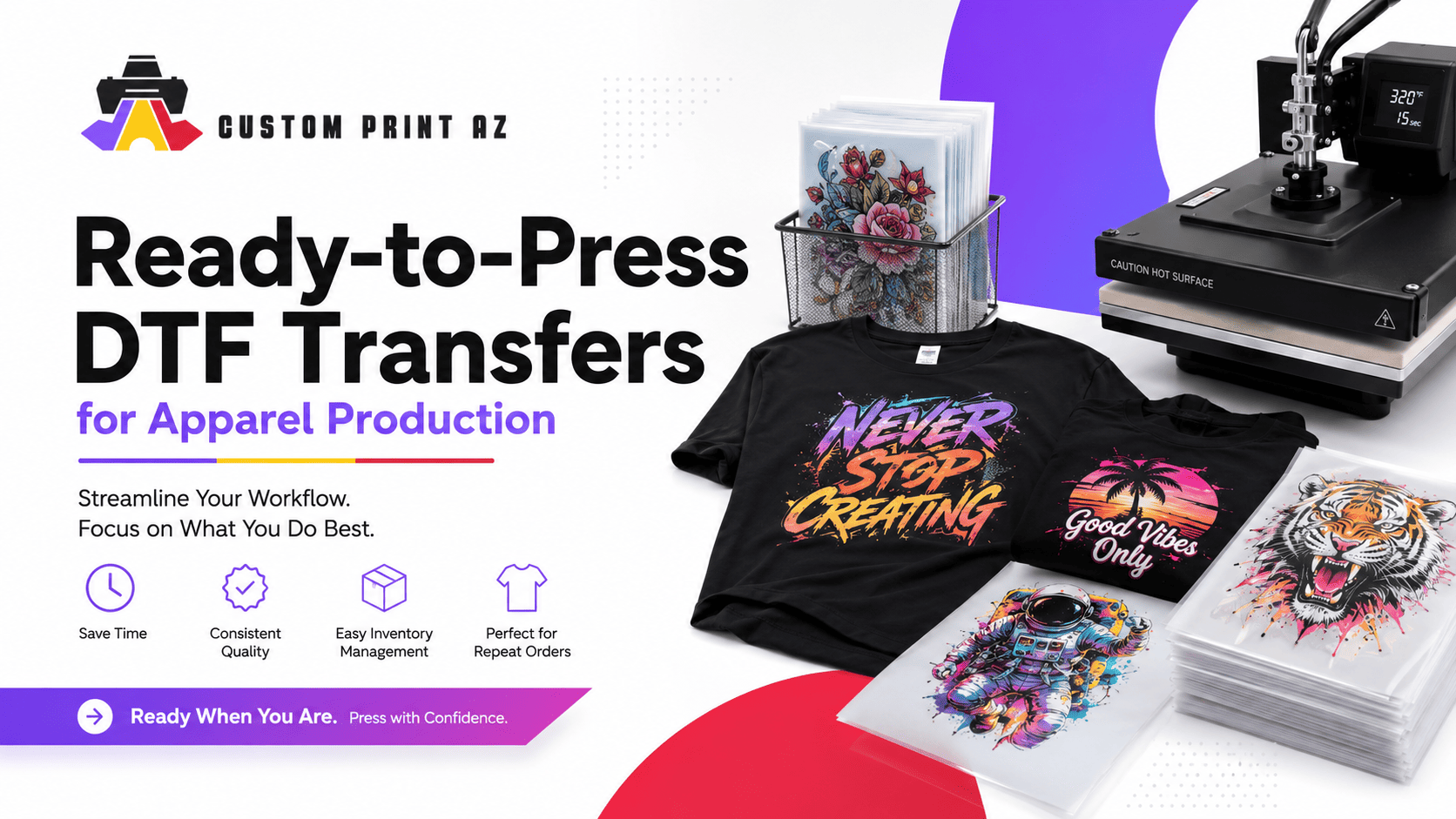
When you are researching ready-to-press DTF transfers, it helps to look beyond how the transfer arrives and think about where it fits in your production workflow. For an apparel shop, small clothing brand, or business with recurring garment production, the more useful question is not simply “What does ready-to-press mean?” It is: Does this order format make sense for the way we actually produce apparel?
Ready-to-press DTF transfers can be especially useful when artwork, transfer dimensions, quantities, and repeat-order details can be decided before the transfers are ordered. Even when the transfers arrive ready for the application stage, garment preparation, job organization, pressing, and final inspection still remain part of the apparel-production workflow.
What Are Ready-to-Press DTF Transfers?
Ready-to-press DTF transfers are DTF transfers prepared for the customer to apply to apparel. Instead of producing the transfer itself, the user can focus on organizing garments, matching transfers to the correct jobs, pressing, and finishing the apparel.
“Ready-to-press” does not mean the transfer has already been applied to a shirt or other garment. The transfer still needs to be applied as part of the user's production process.
If you want to evaluate this format directly, you can review the available ready-to-press DTF transfer options.
What Work Still Remains After the Transfers Arrive?
Receiving a ready-to-press transfer does not mean the apparel order is finished. The shop still needs to organize the job and include the application stage in its production schedule.
After the transfers arrive, the workflow may still include questions such as:
- Which transfer belongs to which customer or garment order?
- Did the correct artwork version arrive?
- Are the transfer sizes and quantities correct for the job?
- Have the transfers been separated into the correct pressing sequence?
- Is enough time reserved for pressing and garment finishing?
- When does the completed apparel need to be ready for final inspection?
This distinction matters for apparel shops working with customer deadlines. Having the transfers ready does not remove the time required for sorting, application, and finishing.
Who Should Use Ready-to-Press DTF Transfers?
Ready-to-press transfers can fit users who want transfer production handled separately while they manage garment pressing and apparel finishing themselves.
The format can make sense across several production models.
One-Off Projects
A user working on a single customer project or a limited apparel run may want finished transfers without maintaining an in-house transfer-production process. In this situation, quantities can be based on the specific project rather than a repeat inventory system.
Small Clothing Brands
A small clothing brand that uses the same designs across multiple production runs can separate transfer production from garment production. Once the artwork and transfer dimensions are established, future orders can begin with information that has already been approved.
Repeat-Production Apparel Shops
For an apparel shop that regularly uses the same customer logos, placements, and approved designs, ready-to-press transfers can fit into a repeat-order workflow. When artwork versions, standard dimensions, and previous quantities are organized, the next order requires fewer production decisions to be rebuilt from scratch.
Approved Artwork Is the Foundation of a Repeat Workflow
Artwork decisions should be settled before a ready-to-press transfer order moves into production. This becomes even more important when the same design will be reordered repeatedly.
For each active design, it can be useful to keep the following information together:
- customer or brand name;
- approved final artwork;
- current design version;
- transfer dimensions;
- placement;
- previous or typical quantity.
If the artwork still needs to be prepared for production, the DTF transfer artwork preparation guide is a better place to handle that step before building the repeat-order workflow.
Why Does Design Version Control Matter?
In a repeat-order workflow, simply having a design file is not enough. The shop also needs to know which version is currently approved.
A customer may update a logo, text, or other artwork detail. If old files remain mixed with the current production version, a reorder can accidentally be built from outdated artwork.
A simple artwork library can prevent this. The goal is not to create a complicated file-management system. It is to avoid having to solve the same question every time an order returns: “Which file is the final one?”
Set Transfer Dimensions Before Reordering
The same artwork may require different physical sizes depending on where it will be placed on the garment. A design used for a left-chest placement may need a different transfer size than the same design used on the back or sleeve.
For repeat production, these variations are easier to manage when they are tracked separately.
- Artwork A — front — size 1
- Artwork A — back — size 2
- Artwork A — sleeve — size 3
The point is not to recommend one universal transfer size. The goal is to preserve the dimensions that have already been approved for each production use.
If transfer size is the next decision in the ordering process, you can review the available DTF transfers by size options.
Individual Transfers or a Gang Sheet?
Ready-to-press and gang sheet are not the same concept.
Ready-to-press describes a transfer format prepared for the application stage, while a gang sheet organizes multiple designs or repeated copies of designs on a single sheet.
An apparel shop may use individual transfers for a simple job with a limited number of designs. If several designs, transfer sizes, or repeated graphics need to be managed within the same production group, a gang sheet may be more practical.
If the main decision is how to organize several graphics on one sheet, the available DTF gang sheet options provide a separate path. In a ready-to-press workflow, the important point is that the chosen format should make cutting, sorting, and garment production easier rather than more complicated.
Can Gang Sheets Be Part of a Ready-to-Press Workflow?
Yes. Gang sheets can be part of an apparel shop's ready-to-press workflow, but using a gang sheet does not define whether a transfer is ready-to-press.
If several repeat designs belong in the same production group, a gang sheet can organize those transfers before they are separated and assigned to the correct garments or customer jobs.
The useful goal is not to fill every available area on the sheet. The layout should reflect the real artwork, dimensions, quantities, and production needs of the order.
Organize Repeat-Order Artwork Before You Need It Again
An apparel business that regularly orders ready-to-press transfers should not have to recreate its production information every time the same artwork returns.
A repeat-order record can include:
- design ID or customer name;
- approved artwork version;
- transfer dimensions;
- placement;
- previous quantity;
- current transfer inventory;
- next expected production need.
A previous quantity should not automatically become the next quantity. Customer needs can change. But historical production information gives the shop a reliable place to begin instead of relying on memory.
Track Transfer Inventory Based on Actual Usage
For repeat production, simply knowing whether transfers are “in stock” may not provide enough information to plan the next order.
Two designs can each have 50 transfers remaining but still have very different reorder priorities. If one design is used every week and the other is used only occasionally, the same inventory count represents two different production situations.
A practical inventory record can track:
- current transfer quantity;
- upcoming customer jobs;
- normal usage frequency;
- whether a reorder is approaching.
The purpose is not to build unnecessary inventory. It is to see when a repeat design is likely to need replenishment before the available transfers become a production problem.
When Should an Apparel Business Reorder Ready-to-Press Transfers?
A repeat design should be reordered before upcoming production demand exceeds the inventory available for that design.
A simple reorder sequence can look like this:
- Check the current transfer inventory.
- Review upcoming apparel orders.
- Calculate how many transfers those jobs require.
- Confirm the approved artwork version and transfer dimensions.
- If current inventory is not enough for the next production period, prepare the reorder.
This turns ready-to-press transfers from an occasional purchase into a more structured replenishment workflow.
Include Pressing in the Production Schedule
A ready-to-press transfer may be ready for application, but the finished apparel is not complete yet.
The transfer still needs to be matched with the correct garment, applied, and included in the shop's finishing and inspection process. That means pressing needs its own place in the production schedule.
For customer-deadline work, it can be useful to plan backward:
- When must the finished apparel be ready?
- How much production time needs to remain for pressing and inspection?
- When do the transfers need to be available?
- If a reorder is required, when should it begin?
This helps separate the transfer-availability deadline from the actual finished-garment deadline.
When Might a Ready-to-Press Workflow Be Unnecessary?
Ready-to-press transfers do not fit every production model.
A business that already handles its own transfer production may prefer a different workflow. A shop that produces only occasional, highly variable projects may also have little reason to build repeat-transfer inventory.
Likewise, if artwork changes constantly or transfer dimensions and quantities have not become stable, it may be too early to organize a repeat-order system around those designs.
Ready-to-press transfers fit most naturally when the production decisions have become repeatable: the approved artwork is known, transfer dimensions are established, garment production is handled by the business, and the same designs are likely to be used again.
Ready-to-Press DTF Transfer Checklist
Before placing an order or building a repeat-production system, confirm:
- Is the final artwork approved?
- Is the active design version clearly identified?
- Are transfer dimensions defined for each placement?
- Is quantity based on the actual production requirement?
- Have you decided between individual transfers and a gang sheet?
- Are repeat-design records current?
- Has existing transfer inventory been checked?
- Have upcoming customer jobs been considered?
- Is pressing included in the production schedule?
- Will the reorder begin before current inventory becomes insufficient?
Ready-to-Press DTF Transfer FAQs
What are ready-to-press DTF transfers?
Ready-to-press DTF transfers are DTF transfers prepared for the customer to apply to apparel. The user can focus on garment pressing and finishing rather than producing the transfer itself.
Are ready-to-press DTF transfers already applied to the garment?
No. A ready-to-press transfer has not already been applied to the garment. Applying the transfer remains part of the user's apparel-production process.
Who should use ready-to-press DTF transfers?
They can fit one-off users, small clothing brands, and repeat-production apparel shops that want transfer production handled separately while they manage garment pressing and finishing.
Can gang sheets be part of a ready-to-press workflow?
Yes. Gang sheets can be part of a ready-to-press workflow when multiple designs or quantities can be organized within the same production group. The two concepts, however, do not mean the same thing.
When should an apparel business reorder ready-to-press transfers?
Reorder before current inventory becomes insufficient for upcoming production. Check the artwork version, transfer dimensions, quantity, current inventory, and upcoming jobs together before placing the next order.
Think of Ready-to-Press as a Workflow Decision
The value of ready-to-press DTF transfers is not limited to the fact that the transfer arrives prepared for application. The more important question is how cleanly that format fits into the apparel shop's production system.
When approved artwork, design versions, transfer dimensions, and inventory records are organized, repeat ordering becomes easier to manage. Individual transfers and gang sheets can then be selected according to actual production needs instead of being treated as interchangeable formats.
Businesses that decide this workflow fits their production model can review the available custom ready-to-press DTF transfer options as the next step.


