

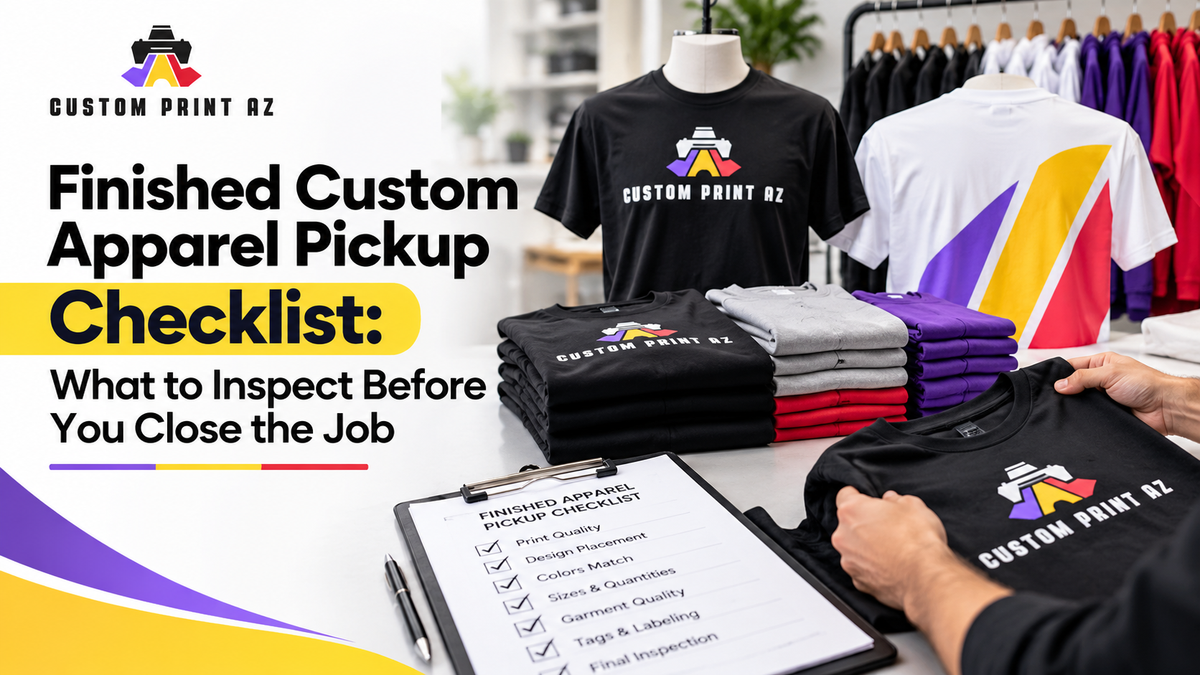
Picking up a finished custom apparel order is more than collecting the boxes and confirming that production is complete. One final decision still belongs to the buyer: does the finished order actually match what was ordered?
This is different from production quality control. At pickup, you do not need to recreate the printer’s technical process, evaluate press temperature, review peel technique, or determine how the decoration was produced. Customer acceptance has a simpler purpose: compare the physical gUse a Simple Job-Closeout Sequencearments in front of you with the final order details you expected to receive.
A practical closeout check should cover the areas most likely to affect whether the order can be accepted as complete: total quantity, garment style and size breakdown, artwork-to-garment matching, agreed print placements, visible garment condition, and any discrepancies that need to be documented before the job is closed.
Start With the Final Order Reference
Before inspecting the garments, open the final order information you plan to use as your reference. Relying on memory becomes risky when an order includes multiple sizes, garment styles, colors, artwork versions, employee groups, or departments.
For example, an order listed only as “50 shirts” does not tell you enough if the actual breakdown is 20 small, 20 medium, and 10 large. The same is true when one order contains different designs for different groups. A correct total quantity does not automatically mean the correct garments were produced for each part of the order.
If you are still deciding whether you need transfers or a completed garment service, the guide to choosing between transfers and finished apparel covers that earlier decision. This checklist begins after finished apparel has already been selected and production is complete.
First Check: Does the Total Garment Count Match?
Begin by comparing the number of finished garments you physically received with the total quantity shown in the final order record.
If the order calls for 48 garments, confirm that 48 garments are actually present. This first count can reveal an obvious shortage, an extra garment, or a piece that may belong to another group or job.
However, do not stop just because the total is correct. A 50-piece order can still contain the wrong size mix, the wrong artwork distribution, or the wrong garment variations while adding up to exactly 50 pieces. Total count is the first reconciliation step, not the final one.
Reconcile the Size and Garment Style Breakdown
Once the overall count matches, compare the order by the variations that matter. Depending on the job, those may include:
- garment style;
- garment color;
- size;
- another garment variation listed in the order.
This matters because a quantity can be correct while the breakdown is wrong. Receiving an extra medium instead of a small does not change the total number of garments, but it changes the order the customer actually receives.
You do not need to turn pickup into a complicated inventory audit. The objective is simply to confirm that the important garment groups listed in the final order are represented correctly in the finished products.
Confirm That the Right Artwork Is on the Right Garment Group
Orders with one design are relatively simple. Orders with multiple logos, names, employee groups, teams, departments, numbers, or artwork variations need another level of checking.
The garments may be counted correctly and the size breakdown may be accurate while the artwork groups are still mixed up. For example, two departments could each have the correct number of shirts, but some garments could carry the other department’s artwork.
For customer acceptance, you do not need to reopen the artwork file and perform a technical prepress review. The question is more practical: is this the design I expected to see on this garment group?
When an order includes several artwork groups, review those groups separately instead of judging the entire job from one representative shirt.
Check the Agreed Front, Back, or Other Placements
The correct artwork can still be applied in a way that does not match the order structure. One group may have been ordered as front-only apparel, another as front-and-back, or different designs may have been assigned to different garment locations.
At pickup, confirm that the agreed placement set is present. Look for obvious mismatches such as a missing back print, artwork placed on the wrong side of a garment, or a placement associated with the wrong garment group.
This should remain a visual order-match check, not a measurement-based production tolerance test. Unless a specific measurement formed part of the order agreement, there is no reason to invent a new technical tolerance during pickup.
Look at Placement Consistency Across Similar Garments
When the same design appears across a group of similar garments, it can also be useful to look at the group together. The goal is not to measure every shirt to the millimeter. Instead, look for a garment that appears noticeably different from the others.
If one print is visibly much higher, lower, or shifted compared with the rest of the same group, record the difference before closing the order.
This is another area where customer acceptance and production QC should remain separate. The production team may have its own manufacturing checks. The buyer is determining whether the finished order visually matches the expected result well enough to accept the completed job.
Check the Visible Condition of the Garments
Pickup is also a useful time to notice obvious garment-condition issues that are easy to see without performing a technical textile inspection.
Focus on visible pickup-stage problems: a clearly damaged garment, an obviously different item, or a piece whose condition stands out from the rest of the order. You are not trying to predict long-term garment performance or evaluate every possible manufacturing variation.
The purpose is narrower: identify any visible mismatch or damage that could affect your acceptance of the finished order while the garments and order record are still together.
Keep Employee, Team, and Department Groups Separate
As finished apparel orders become more complex, checking only the overall count becomes less useful. If the job contains multiple employee groups, team designs, departments, names, or numbers, reconcile each group against its expected quantity.
Suppose Team A should receive 12 garments and Team B should receive 18. Thirty finished garments may be present, but that does not prove the allocation is correct. Fourteen Team A garments and 16 Team B garments still total 30.
A simple group-by-group check helps catch this type of discrepancy before the apparel is distributed to employees, teams, departments, or other recipients.
Document Discrepancies Before You Treat the Job as Closed
If something does not match, avoid reducing the issue to a vague note such as “order wrong.” Record exactly what differs from the order reference.
A useful discrepancy note can identify:
- the expected quantity and the quantity received;
- the affected garment style, color, or size;
- the relevant artwork group;
- the placement difference;
- the visible condition issue;
- which specific garments appear to be affected.
The exact resolution can depend on the order and the parties involved. From an acceptance standpoint, the important step is to make the difference clear before the job is treated as fully closed.
Whenever practical, document discrepancies before the garments are separated and distributed. Once shirts are handed to different employees, teams, departments, or locations, it can become harder to reconnect a specific issue with the original physical item.
Customer Acceptance Is Not the Same as Production QC
This distinction keeps the pickup process focused. A customer receiving finished apparel does not need to repeat every technical production check performed by the printer.
Production QC concerns how the job was produced according to the production process being used. Customer acceptance concerns whether the completed order matches the order expectations that matter to the buyer.
That means the finished-order questions are straightforward:
- Did I receive the correct number of garments?
- Are the correct styles, colors, and sizes present?
- Is the right artwork on the right garment groups?
- Are the agreed placements present?
- Is there an obvious missing, different, or visibly problematic item?
For broader DTF ordering and production planning, the DTF transfer ordering and production guide provides additional context. Finished-order acceptance is a separate decision point that happens at the end of that broader workflow.
Use a Simple Job-Closeout Sequence

You do not need a complicated procedure to make finished-apparel pickup more reliable. A repeatable sequence can reduce the chance of skipping an important order detail:
- Open the final order reference.
- Count the total finished garments.
- Compare the style, color, and size breakdown.
- Match each artwork group to the correct garments.
- Confirm the agreed front, back, or other placements.
- Review visible placement consistency and garment condition.
- Document any discrepancy specifically.
- Then decide whether the finished order is ready to be accepted as complete.
This sequence reconciles the order without turning pickup into a technical production audit.
Planning Your Next Finished Apparel Order

Choosing a finished-apparel service and accepting a completed order are two different stages. First, the buyer decides whether finished garments are the right service format. After production, the buyer verifies that the physical order matches what was expected.
If a future order requires a finished-apparel or pressing-service route, the T-Shirt Heat Press Service page is a relevant next step to review.
Frequently Asked Questions
What should I check first when picking up a finished custom apparel order?
Start by comparing the final order reference with the total number of garments received. Then verify the garment styles, colors, sizes, and any separate artwork groups. A correct total quantity does not necessarily mean the order breakdown is correct.
Do I need to inspect every garment individually?
Not always. The inspection depth should match the complexity of the order. A simple single-design order may be easier to reconcile, while multi-size, multi-artwork, multi-department, or personalized orders benefit from group-by-group verification and enough visual review to identify obvious discrepancies.
Is a pickup inspection the same as production quality control?
No. Customer acceptance focuses on whether the finished order matches the buyer’s order expectations. It does not require the customer to repeat the printer’s technical production checks.
What should I do if a garment is missing or does not match the order?
Document the discrepancy before treating the job as closed. Identify the affected size, garment style, artwork group, placement, quantity, or visible condition issue as specifically as possible.
Match the Physical Order to the Order Record Before Closing the Job
A finished custom apparel pickup check should not recreate the entire production process. Its purpose is to confirm that the completed physical order matches what the customer expected to receive.
Is the total count correct? Does the size and garment breakdown match? Is the artwork assigned to the right groups? Are the agreed placements present? Is there a visible discrepancy that still needs to be recorded?
Answering those questions before closing the job turns pickup into a clear customer-acceptance step instead of simply the moment when the garments change hands.